Challenge
How might people record and look back on their experiences more faithfully, for a fuller and more objective self-reflection?
A toolkit that turns daily writing and reflection into a habit, helping people understand themselves and cope with negative emotions
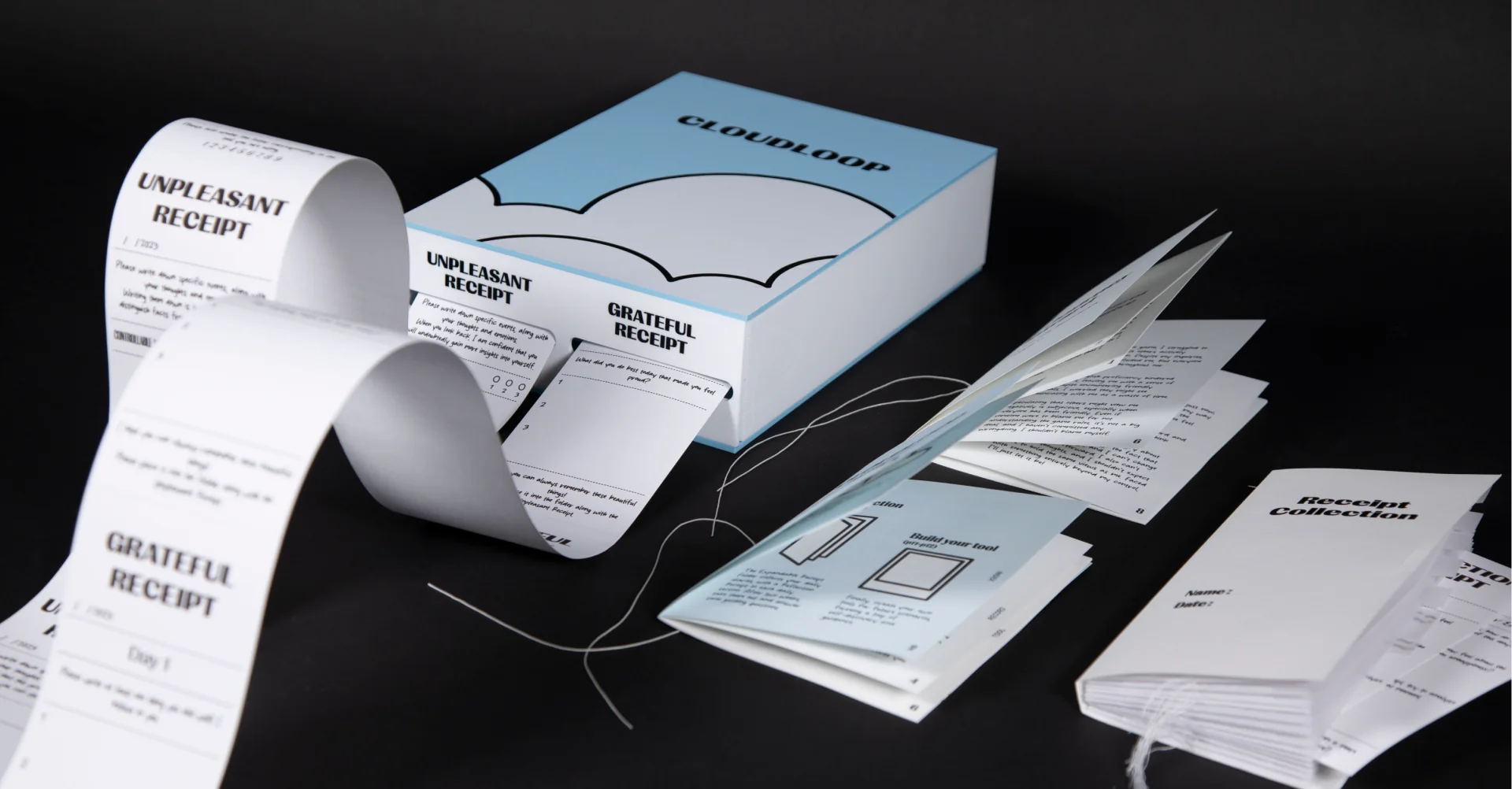
How might people record and look back on their experiences more faithfully, for a fuller and more objective self-reflection?
Research shows that our memories change with how they are formed and stored, often reflecting our own biases. That limits how objective self-reflection can be: when we look back, we see a version our memory has reworked, not the event itself.
Turn the link between memory and self-discovery into a small, warm, tangible toolkit. Through daily writing and reflection, it helps people capture how they feel in the moment, look at it more rationally, and let the past guide what they do next. The kit runs over two weeks, so reflection becomes an easy habit.
Memory is less reliable than we think: the brain keeps rewriting it, and it quietly shapes how we see ourselves. To understand how memory and self-reflection connect, I researched from three angles: a psychological consultant, five days observing myself, and interviews about how others came to know themselves.
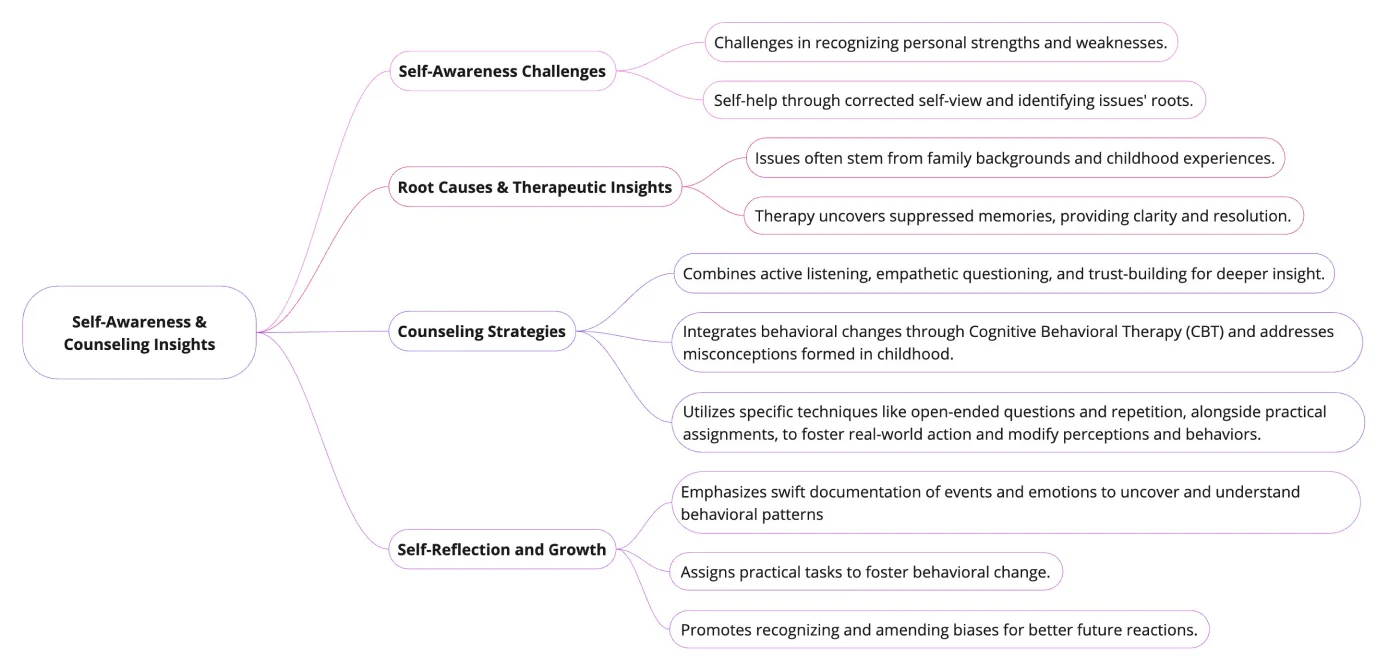
An online interview with a psychological consultant from China, to bring established counseling techniques, such as CBT, into my design approach.1
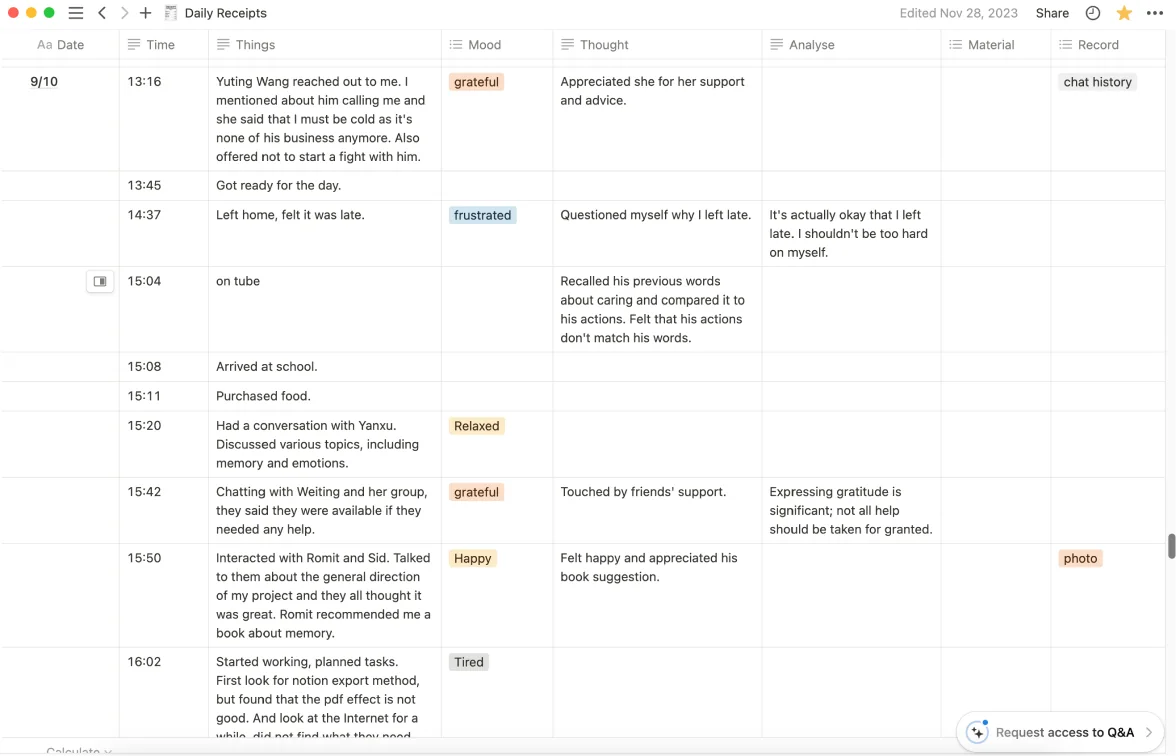
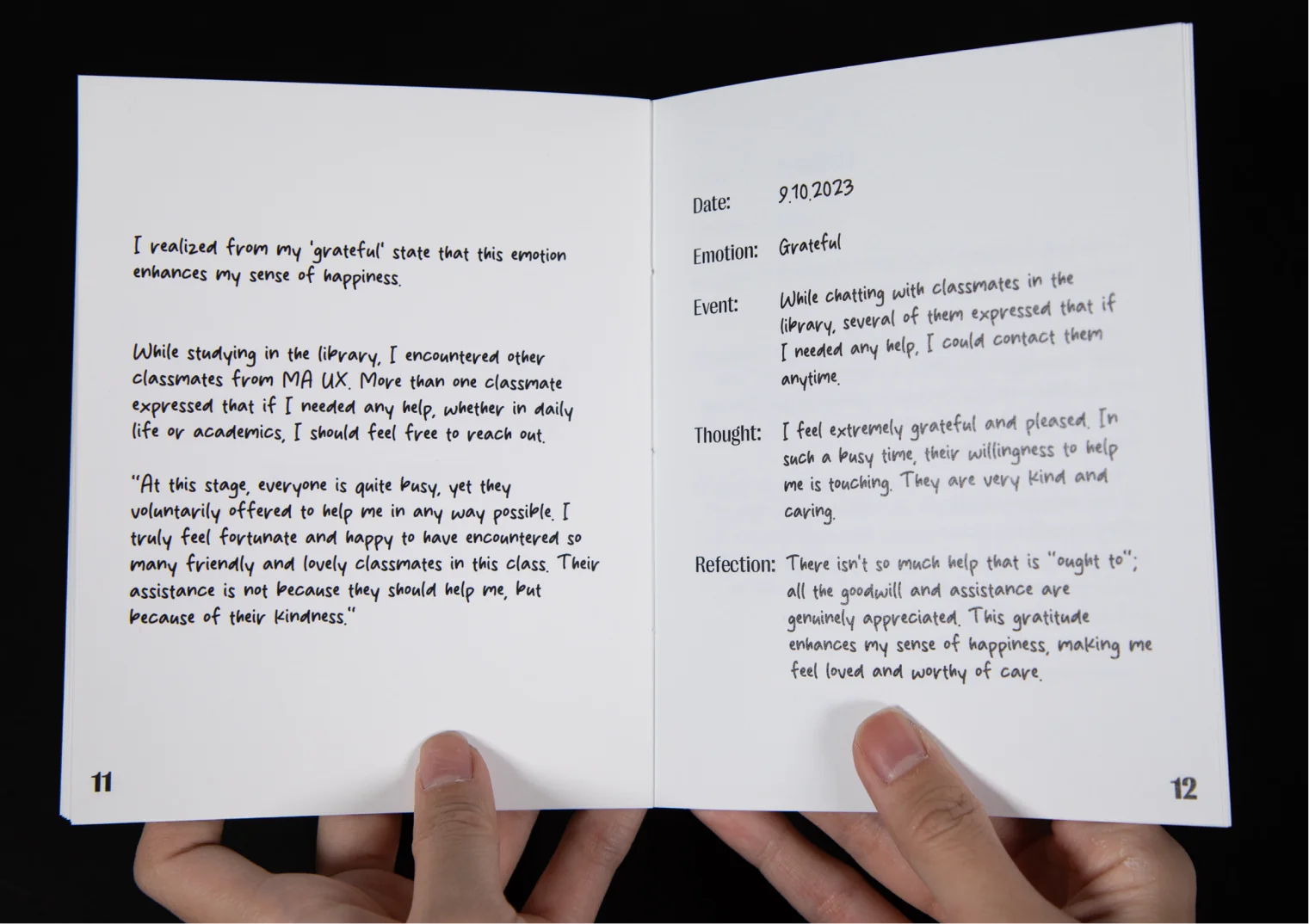
Five days of self-observation. I logged every occurrence, broke it into emotion, event and thought, and arranged them for later review.1
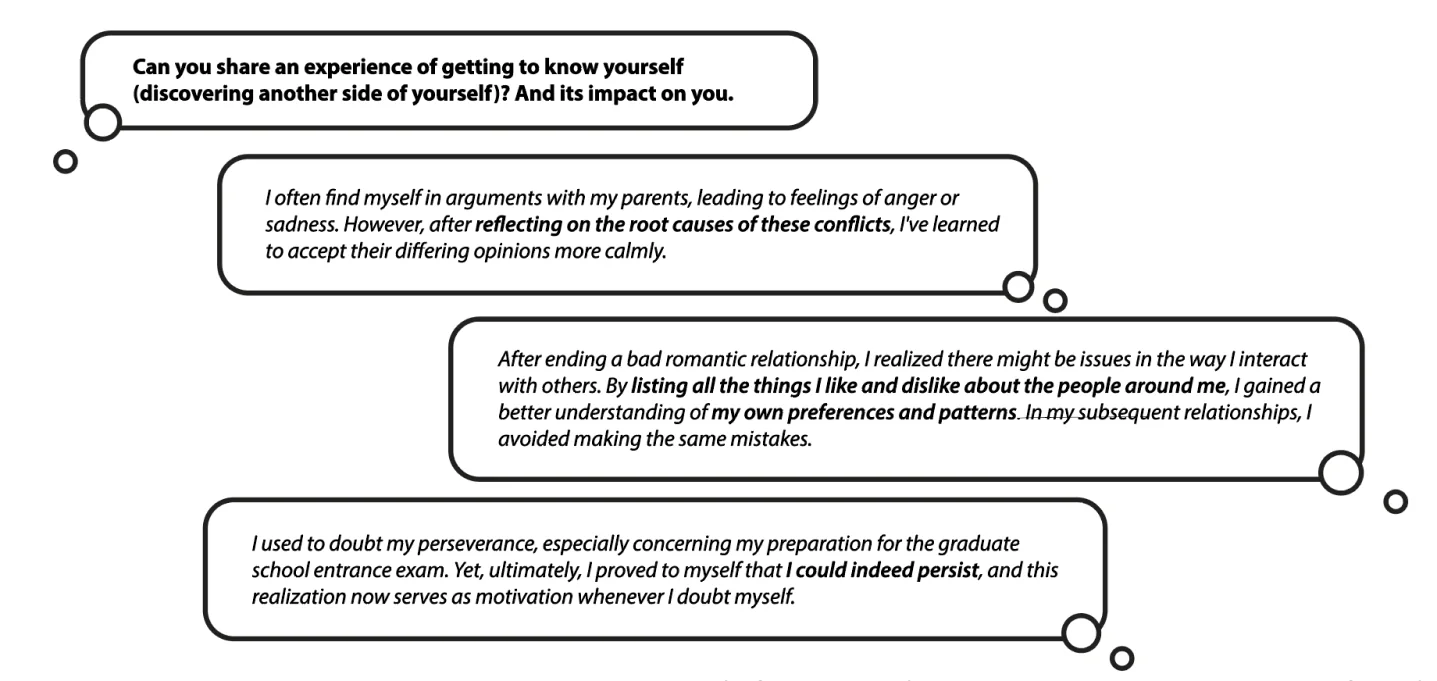
Directed storytelling: “Can you share an experience of getting to know yourself, and its impact on you?” to see whether my insights held for others.1
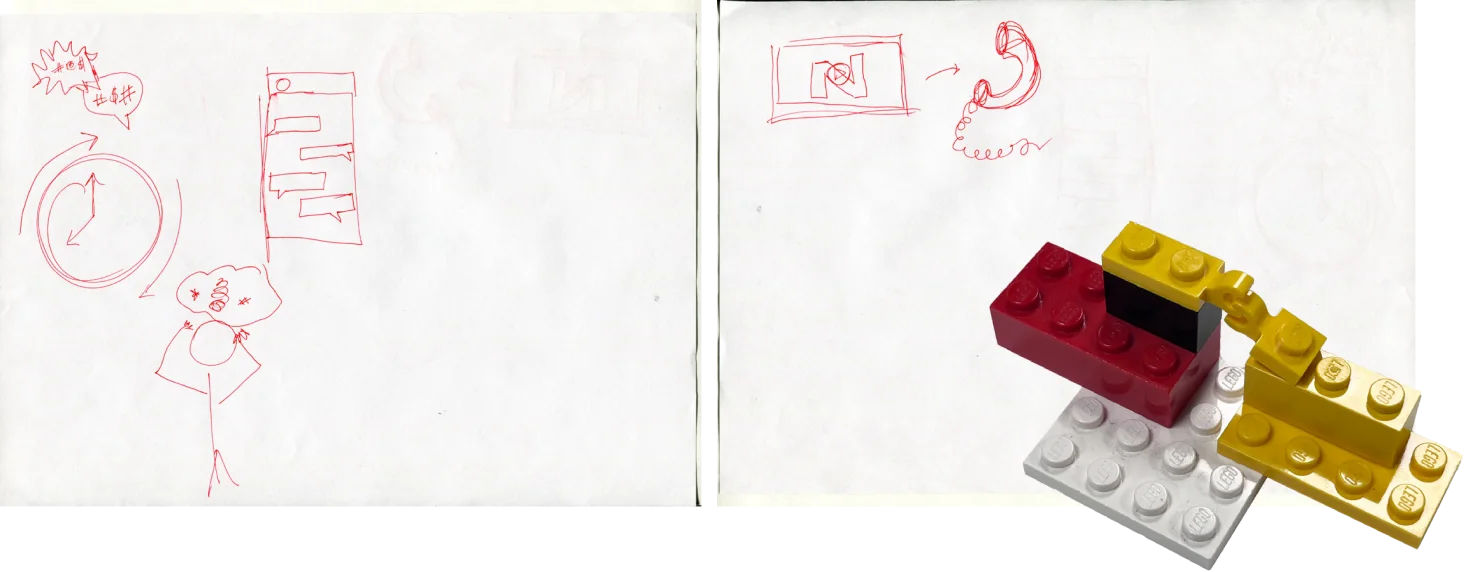
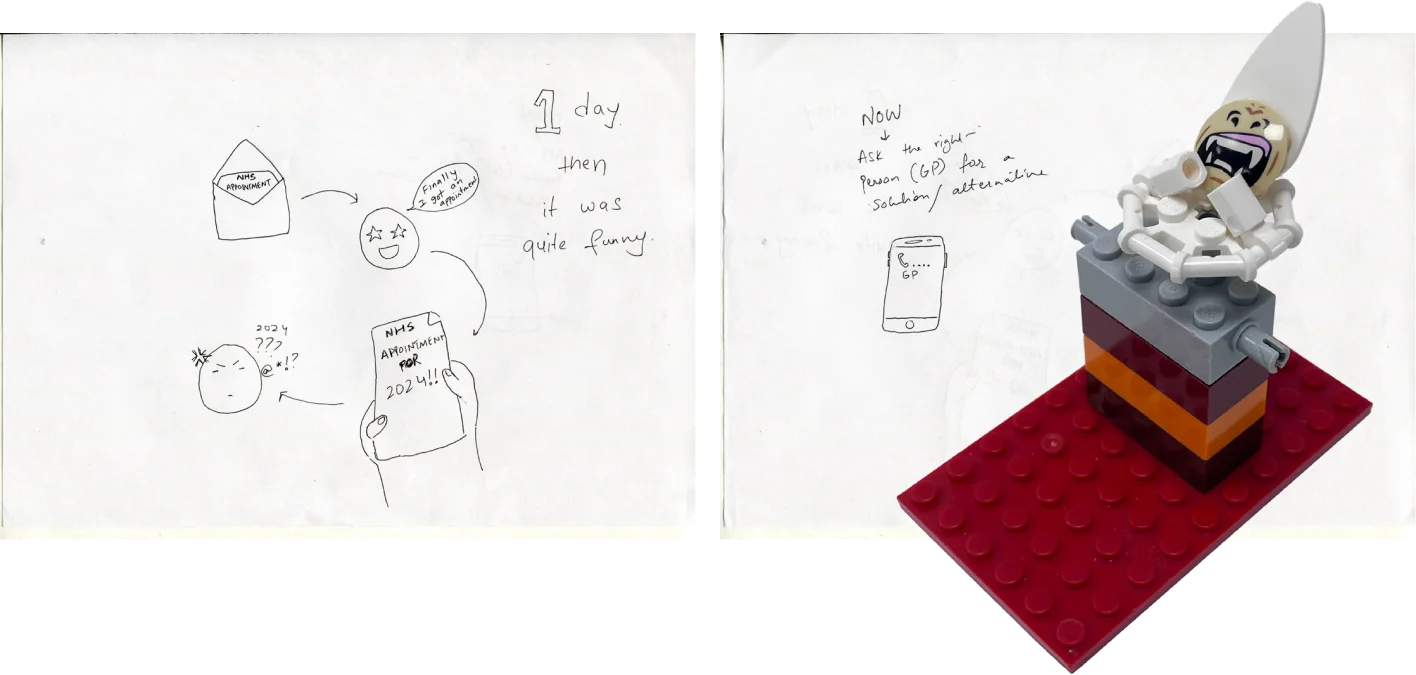
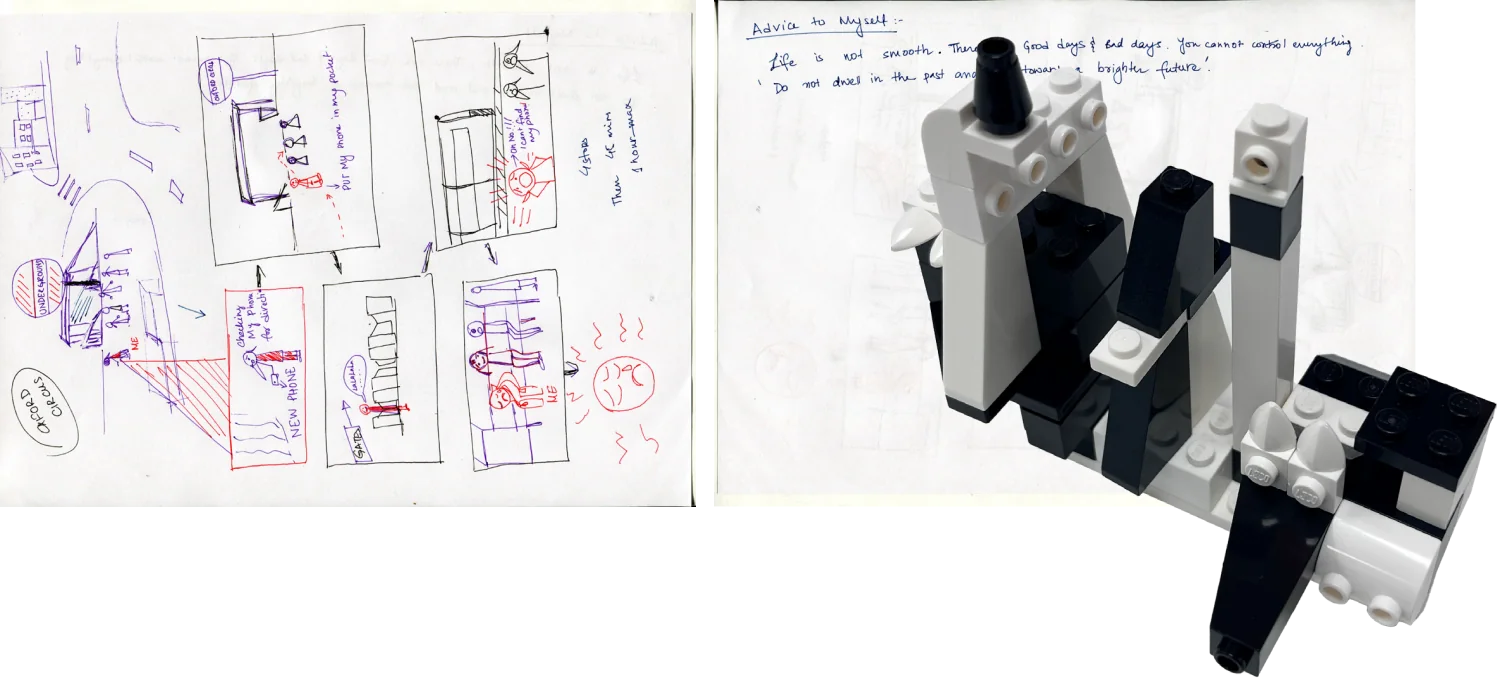
To see how self-reflection can shape future actions, I ran a workshop with 10 people in three phases.
Participants drew a recent event that had affected them emotionally but was now resolved.
On the back, they wrote the advice their present self would give their past self.
With LEGO, they built a model of that advice, a tool to help themselves.
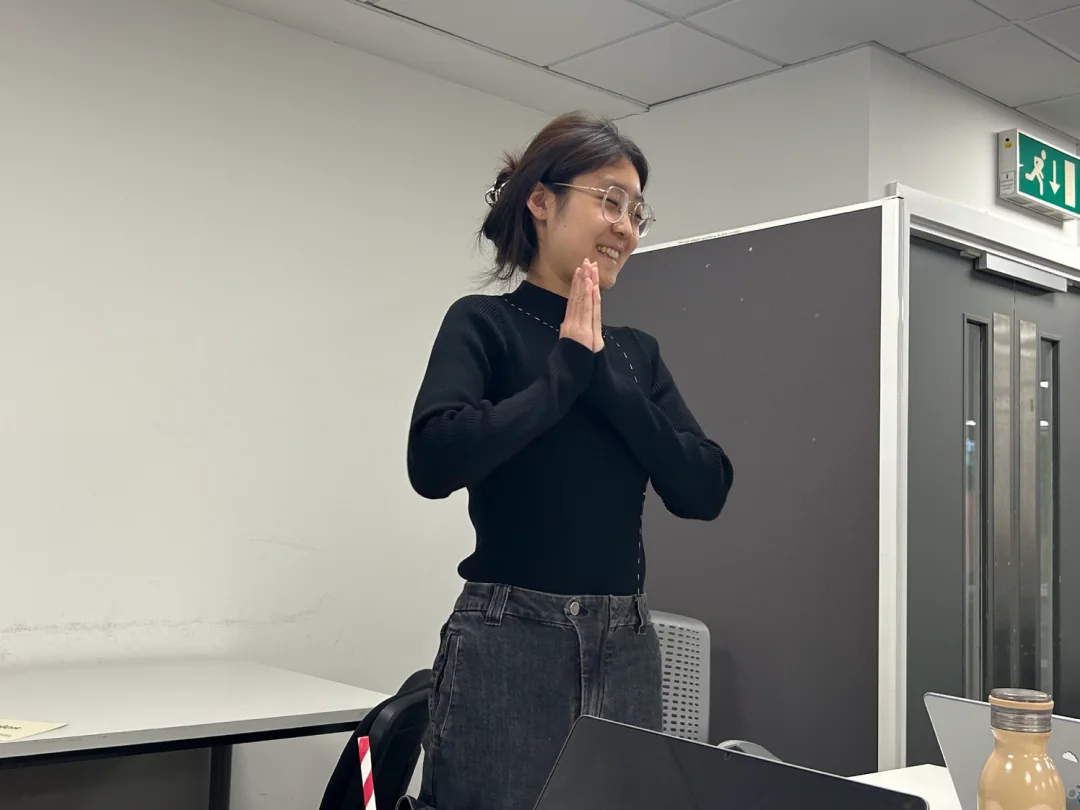
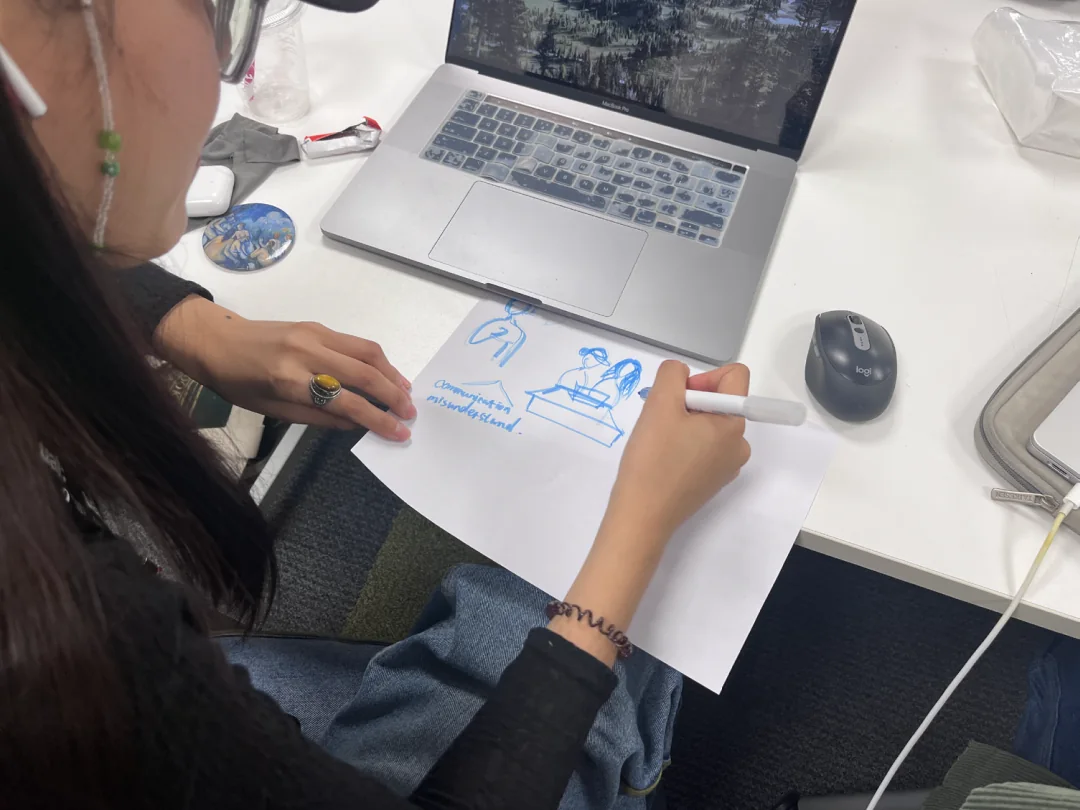
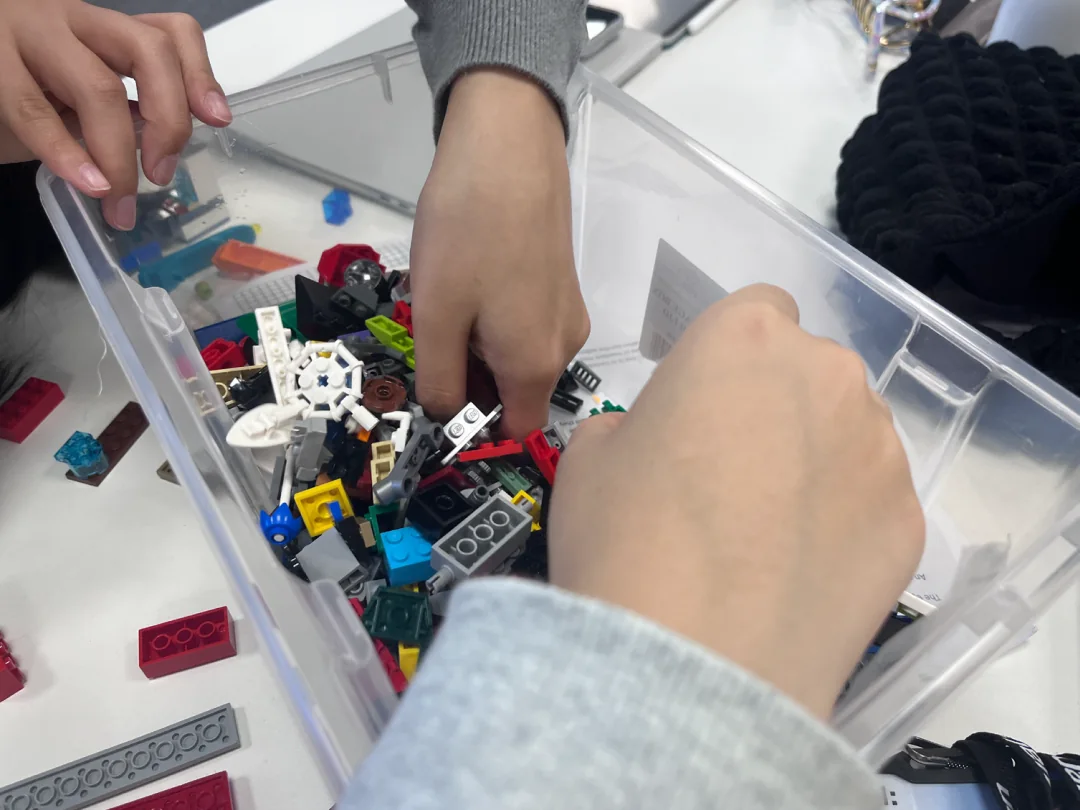
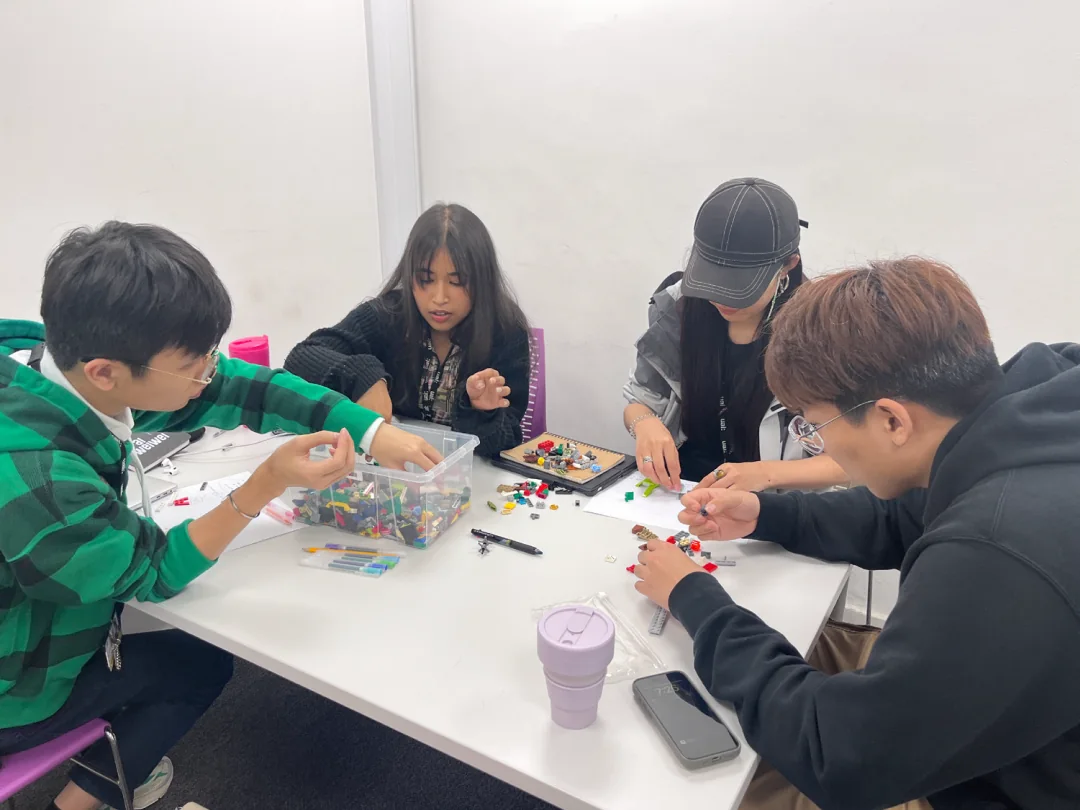
This showed how reflection can guide what we do next, and inspired me to build this advice into the kit, so users can weigh up a situation and pick the right tool for a negative emotion.
Along the way I found that events could be sorted by how much control the person had over them: ControllableSemi-controllableUncontrollable
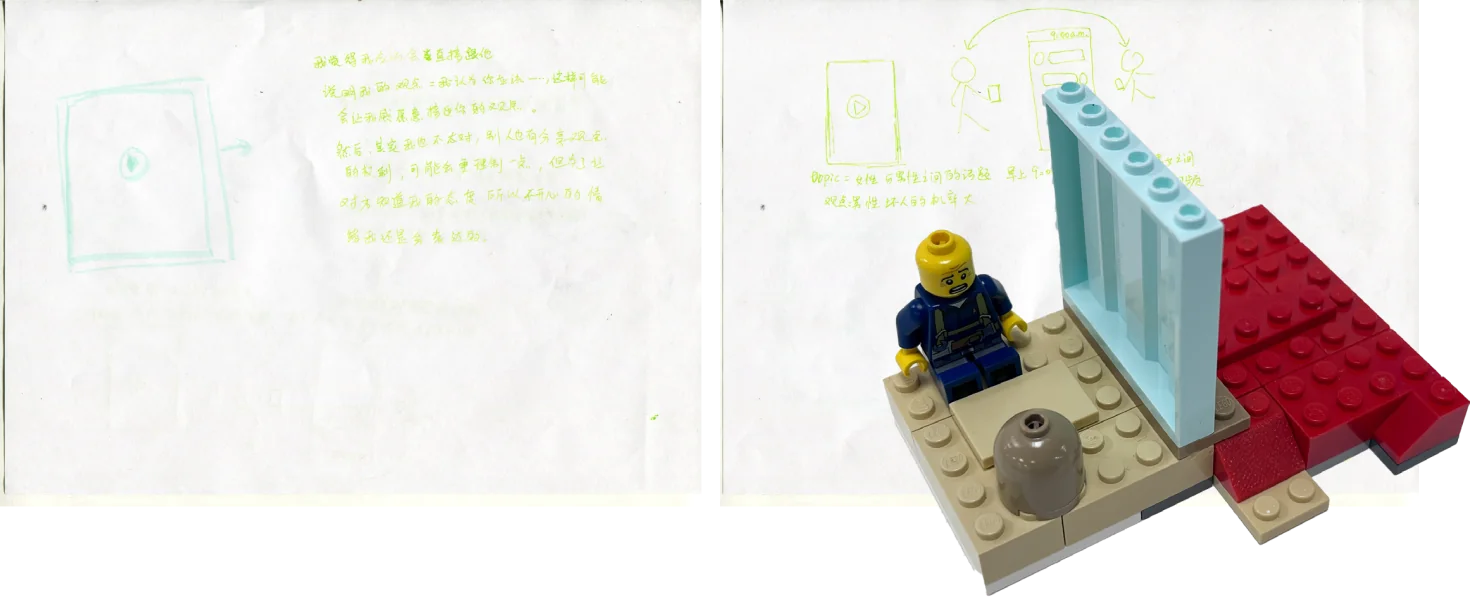
Calm down and communicate patiently.
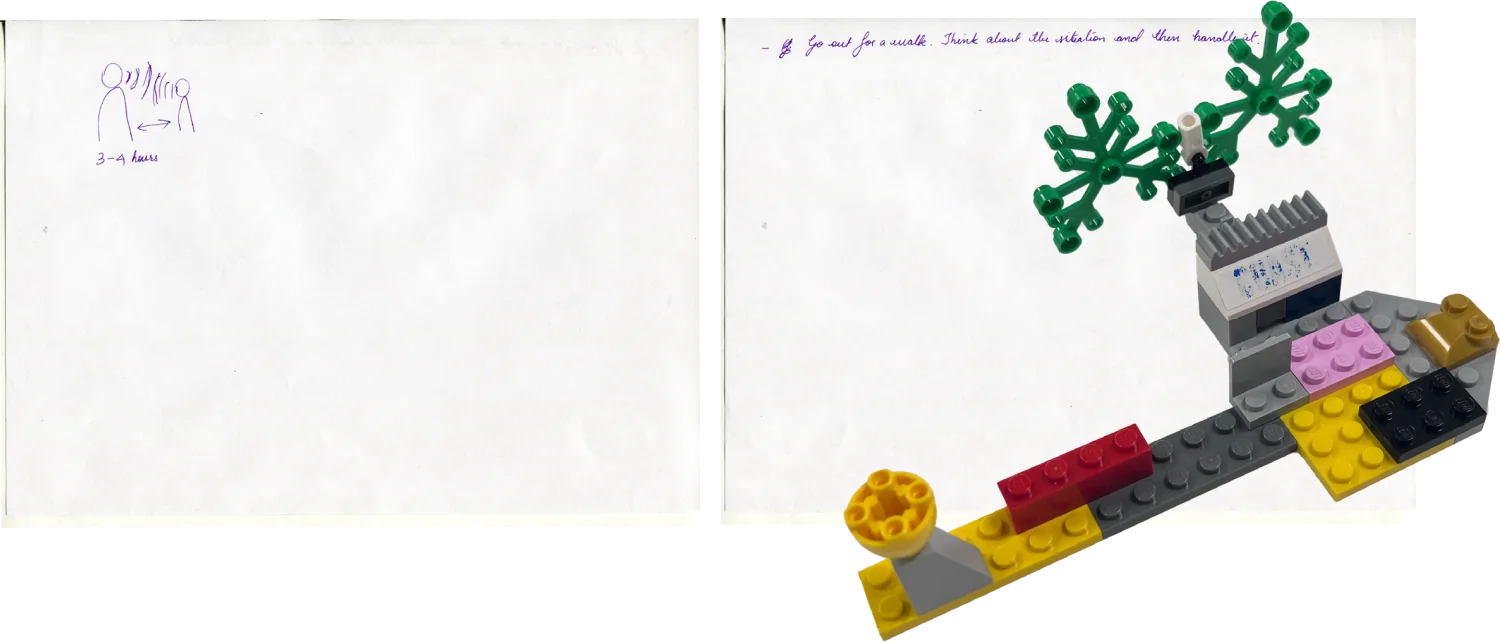
Go for a walk in the park, then calm down before talking.
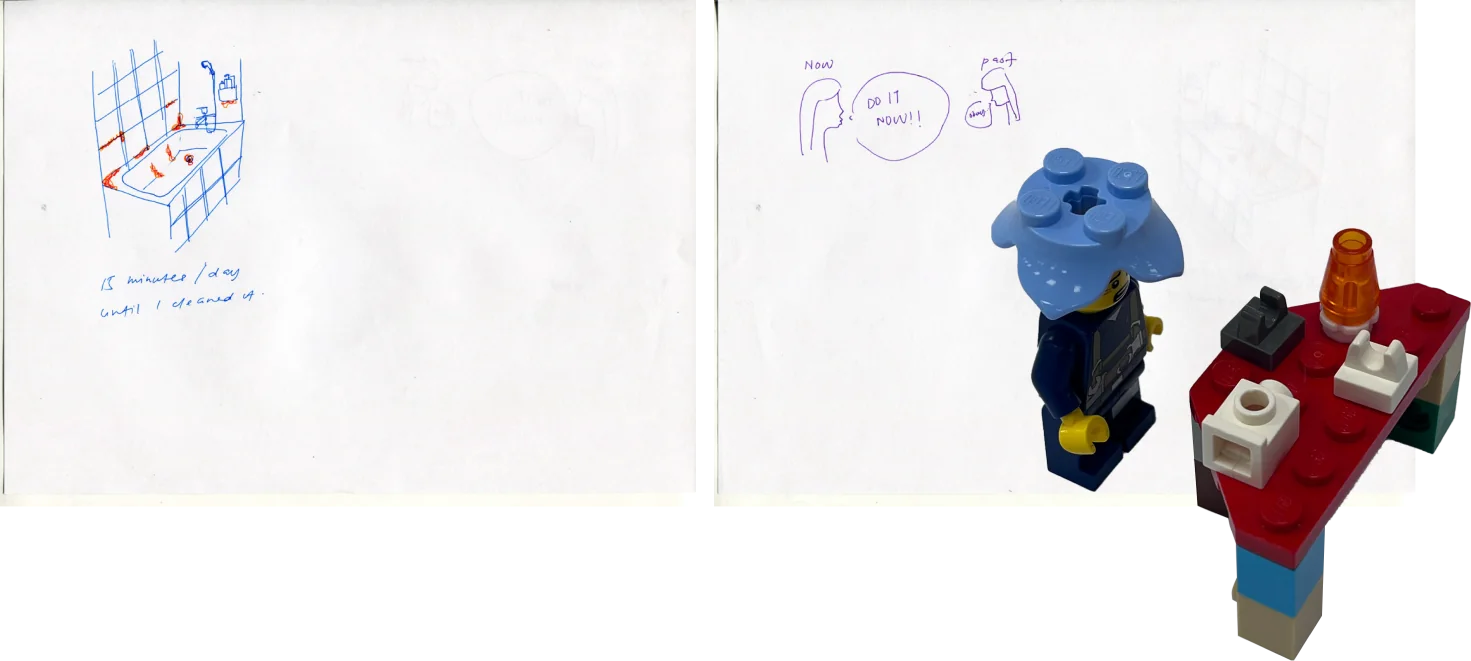
Think of her good side, and look at it from another angle.
Face the problem, don’t run away, and think of the friendship.
Remind yourself you’re not alone, and reach out to a friend.
Recall the good and bad things in your own life.
Through the design process, I pictured a toolkit that moves through three stages:
A tangible toolkit that makes daily recording a small ritual, with materials for logging and tools for managing negative emotions.
Two weeks, so there is enough to look back on and reflect on at the end.
Three pieces to prototype: what people write on, the booklet that explains the kit, and the tool for a bad moment.
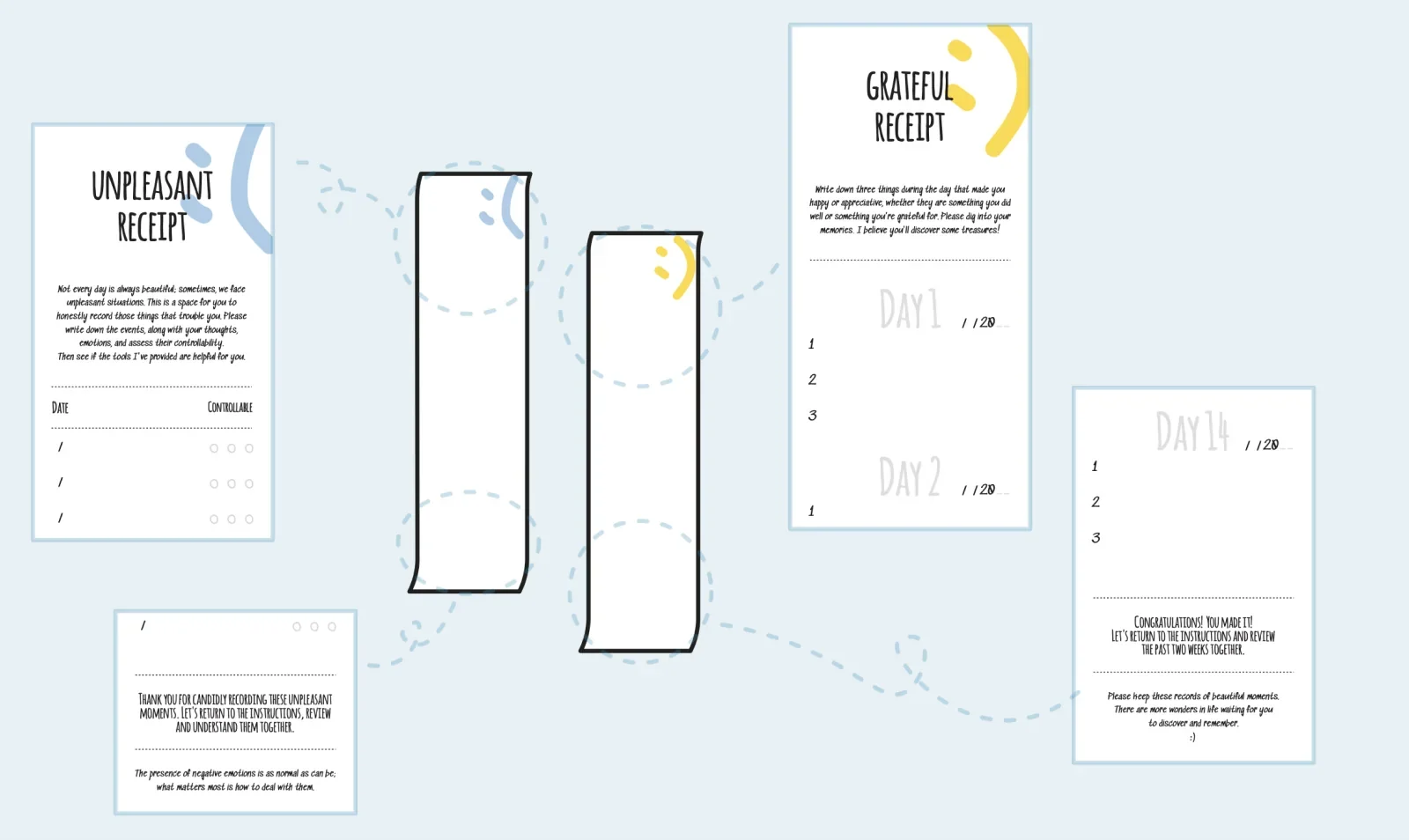
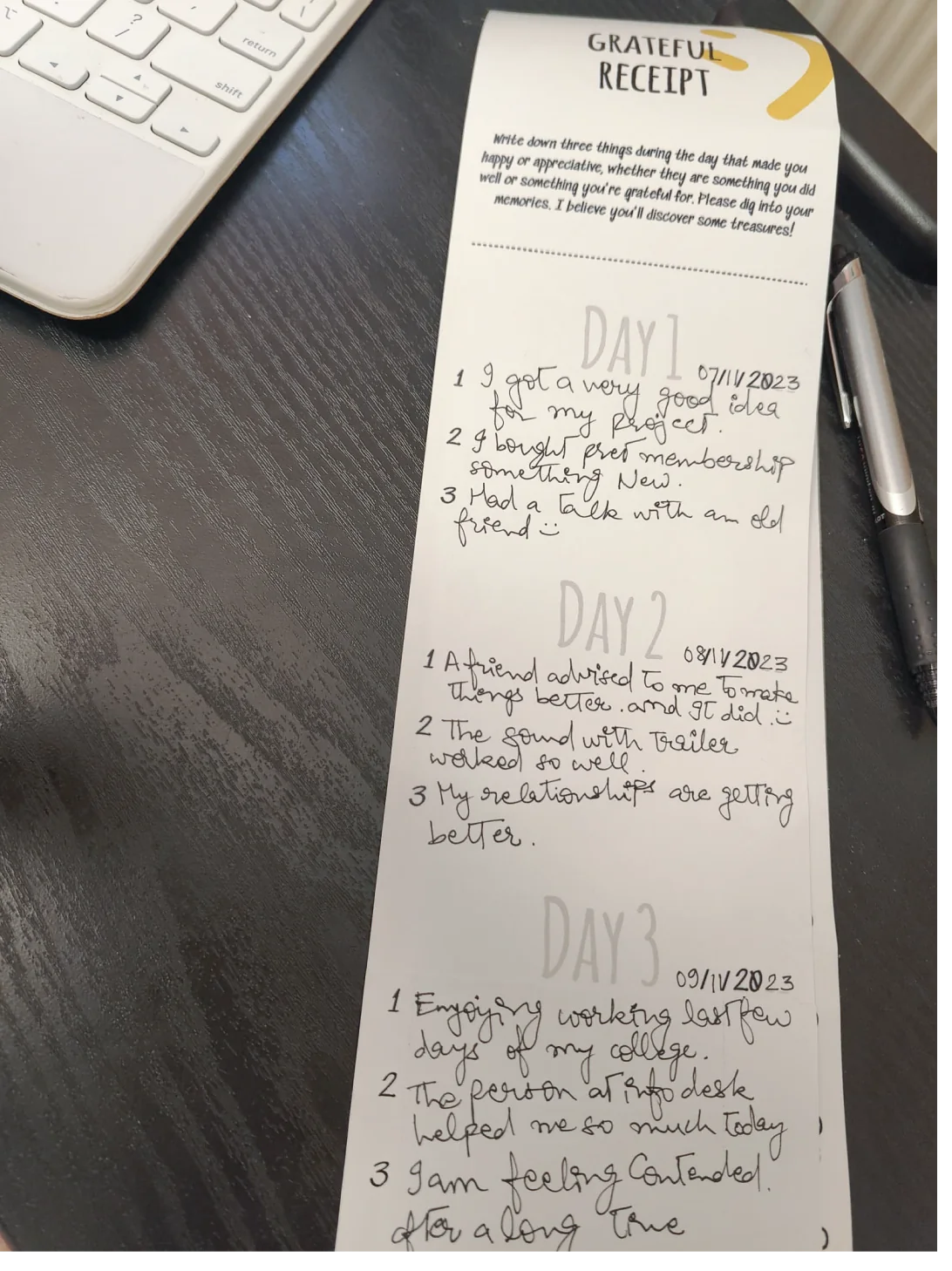
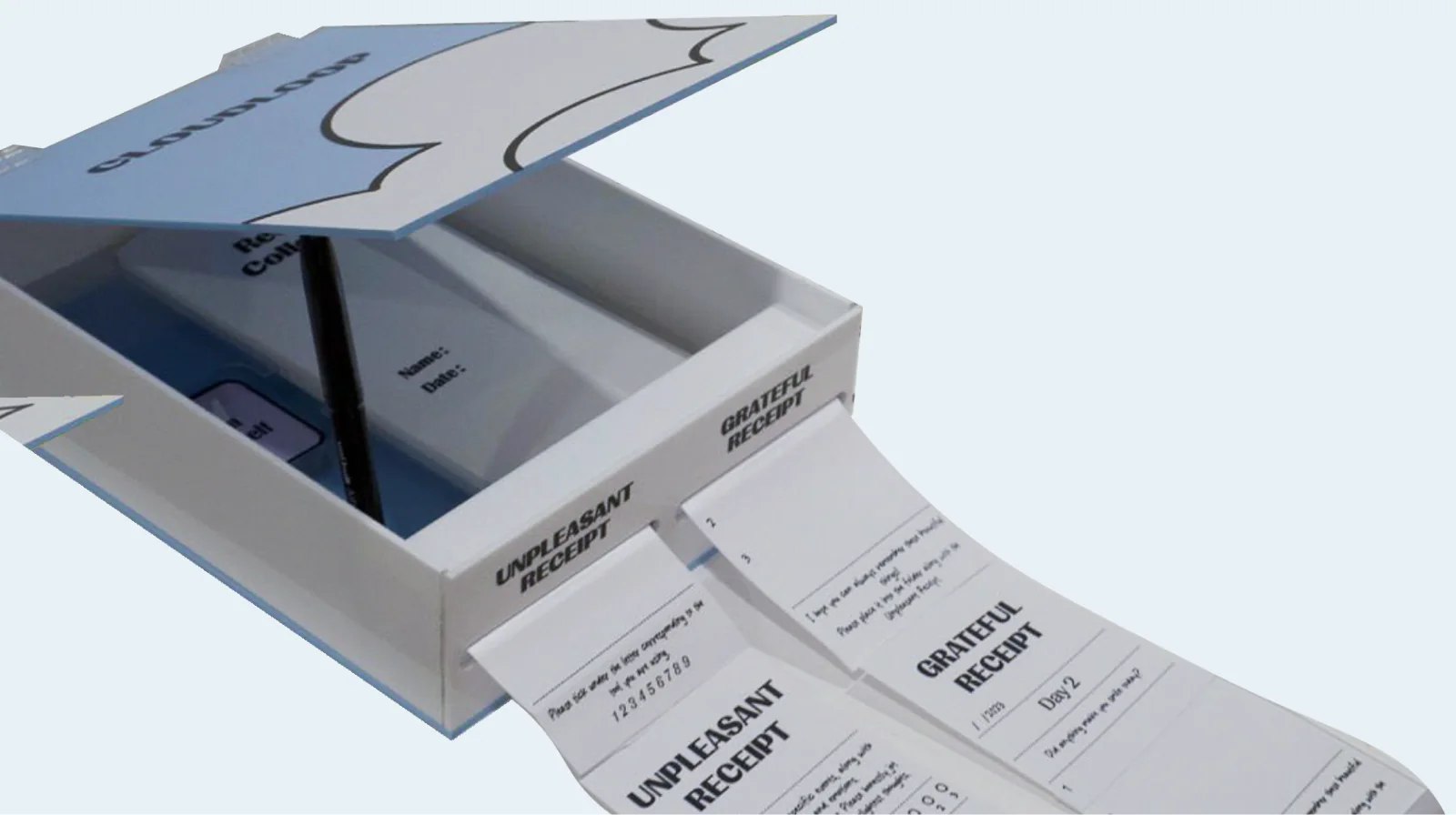
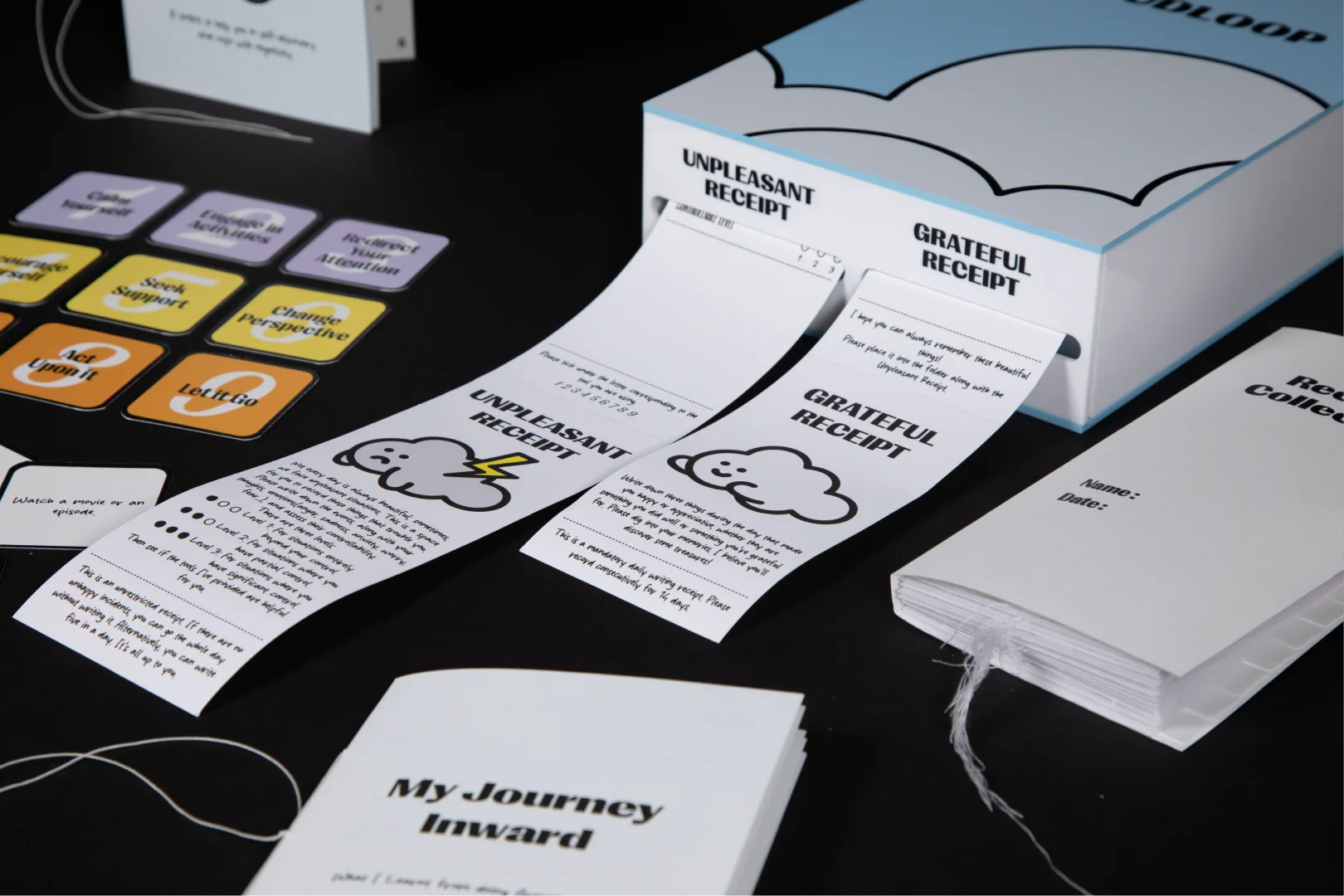
Inspired by everyday receipts: a Grateful Receipt for three good things each day, and an Unpleasant Receipt for negative emotions.1
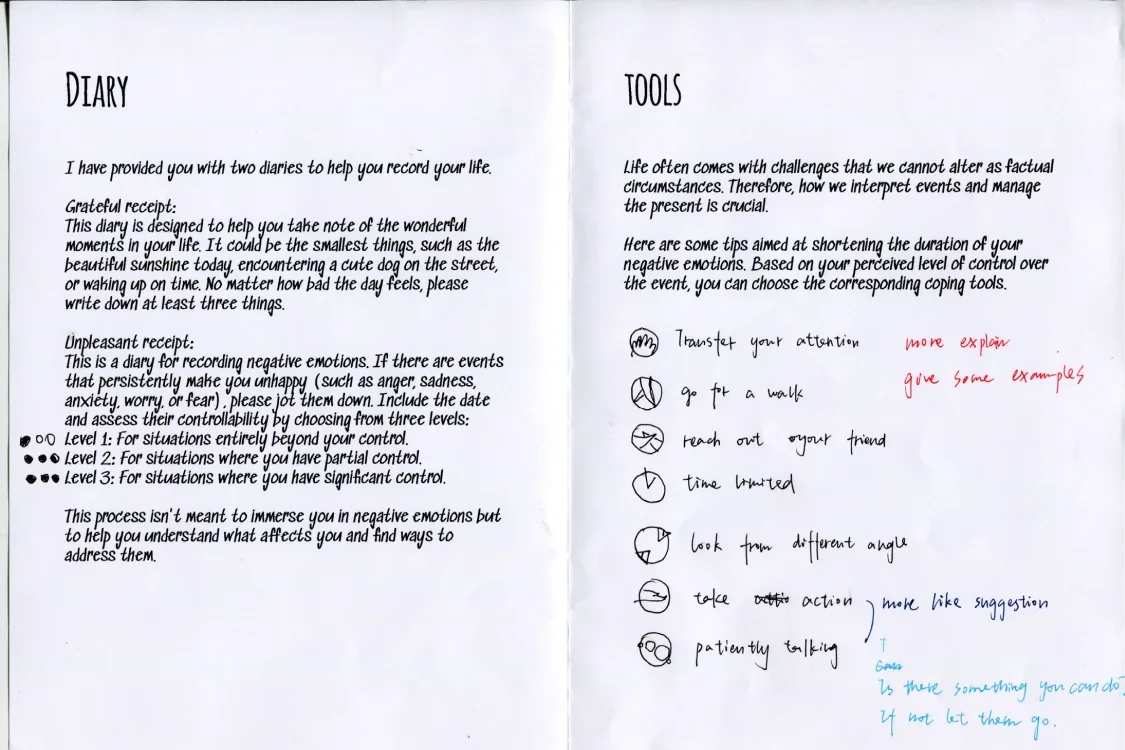
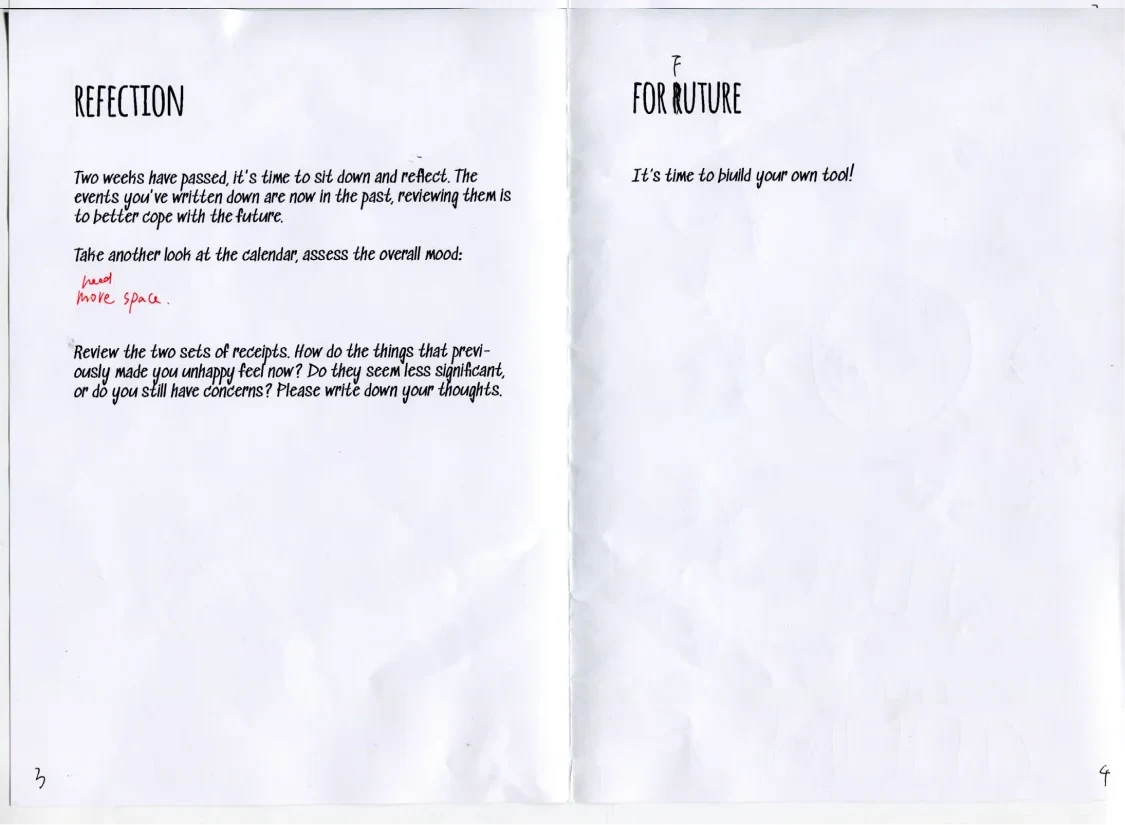
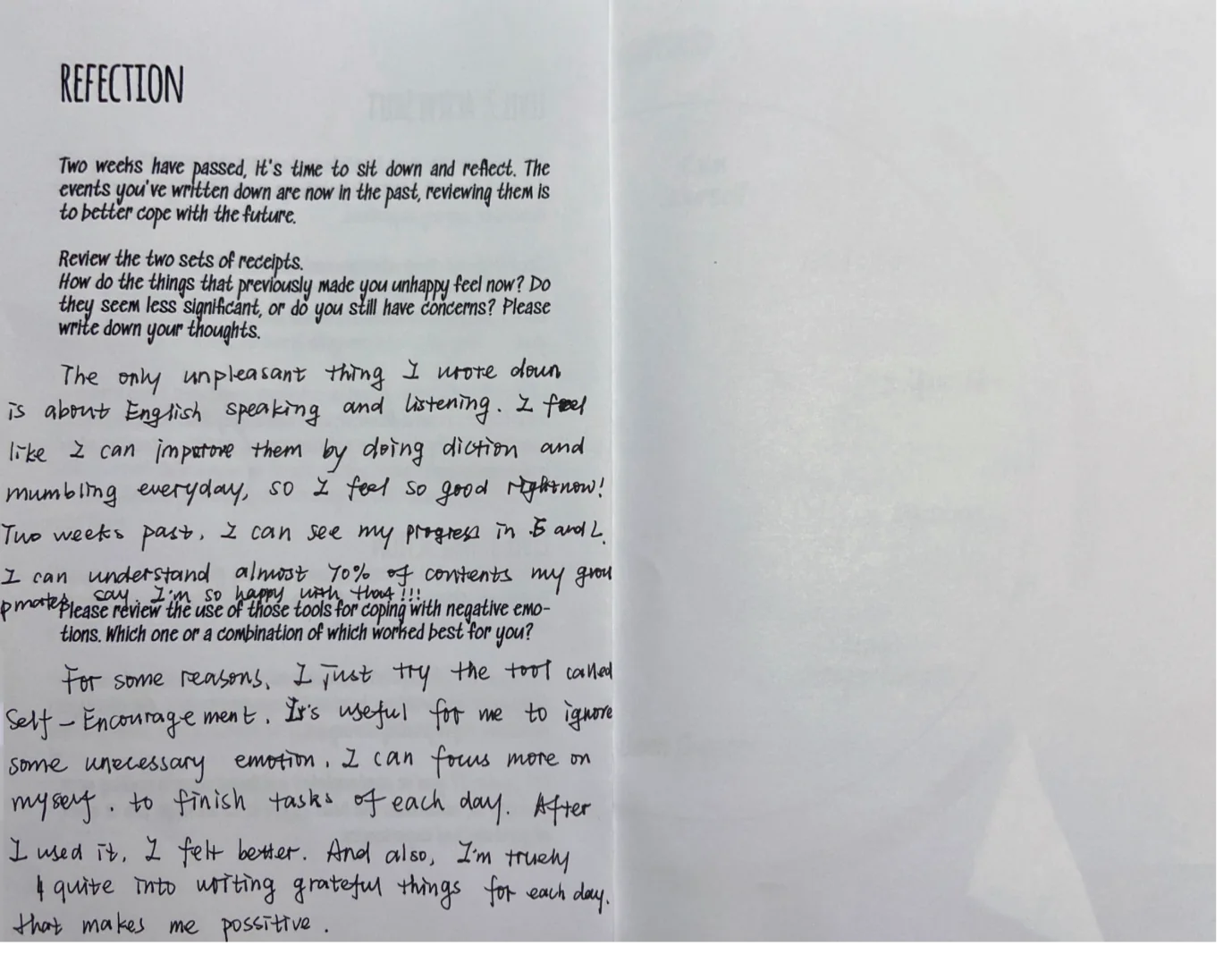
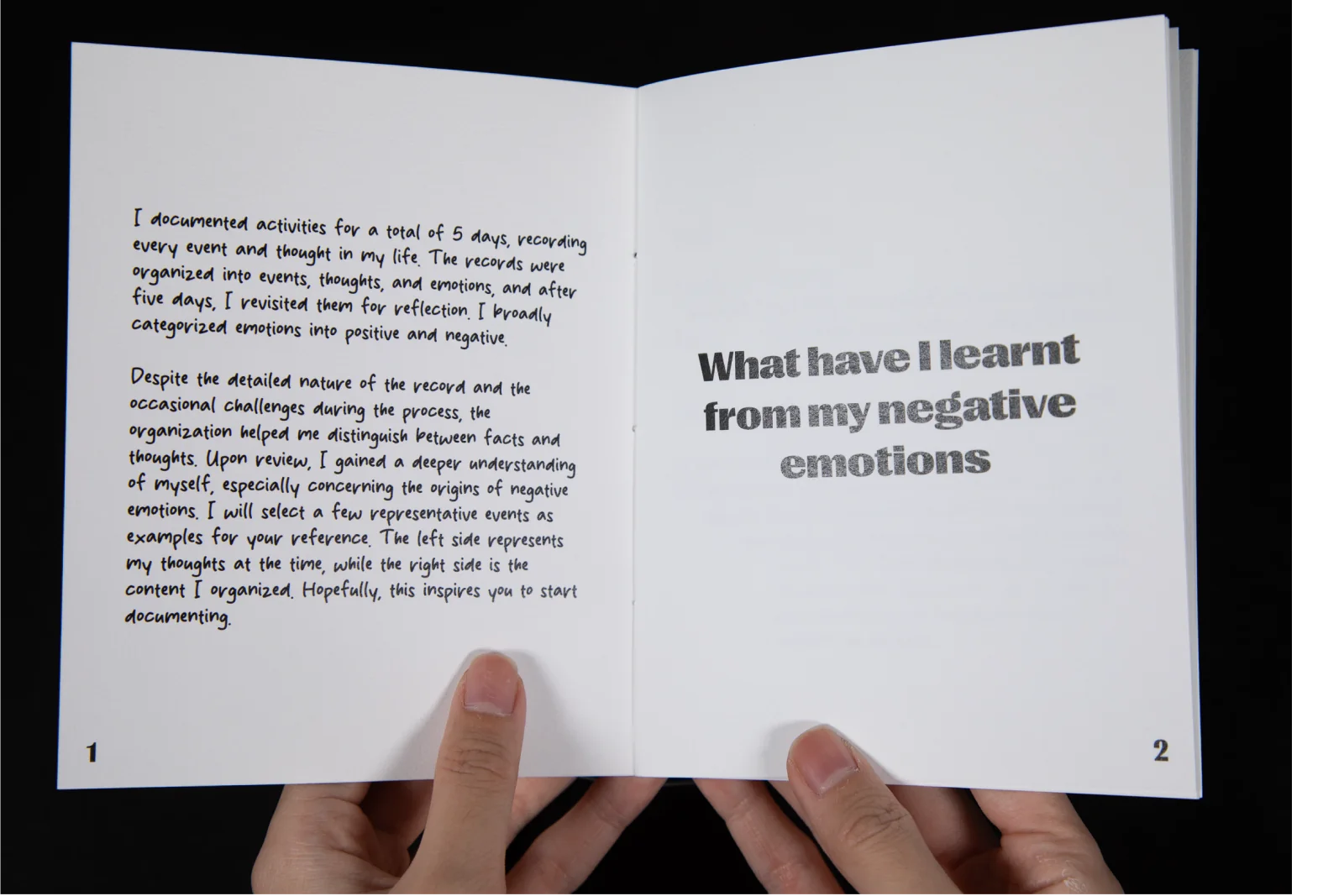
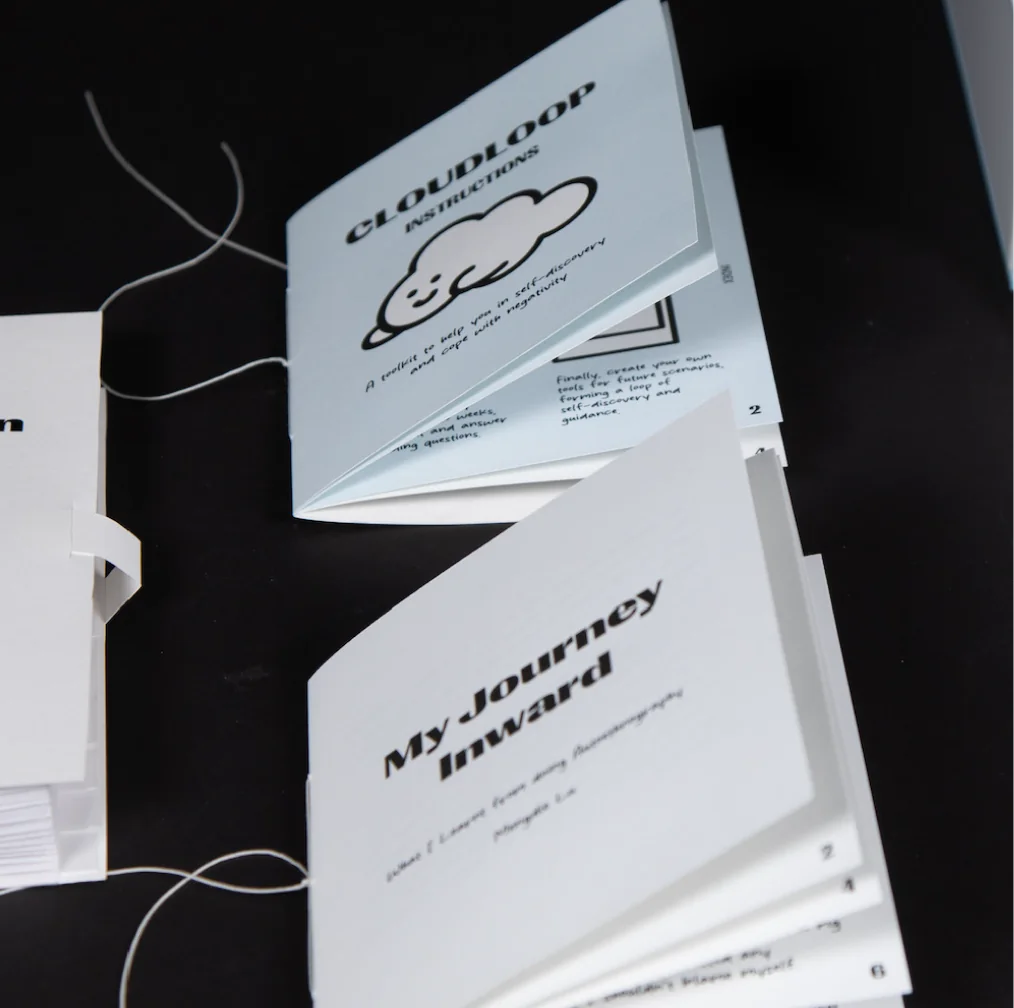
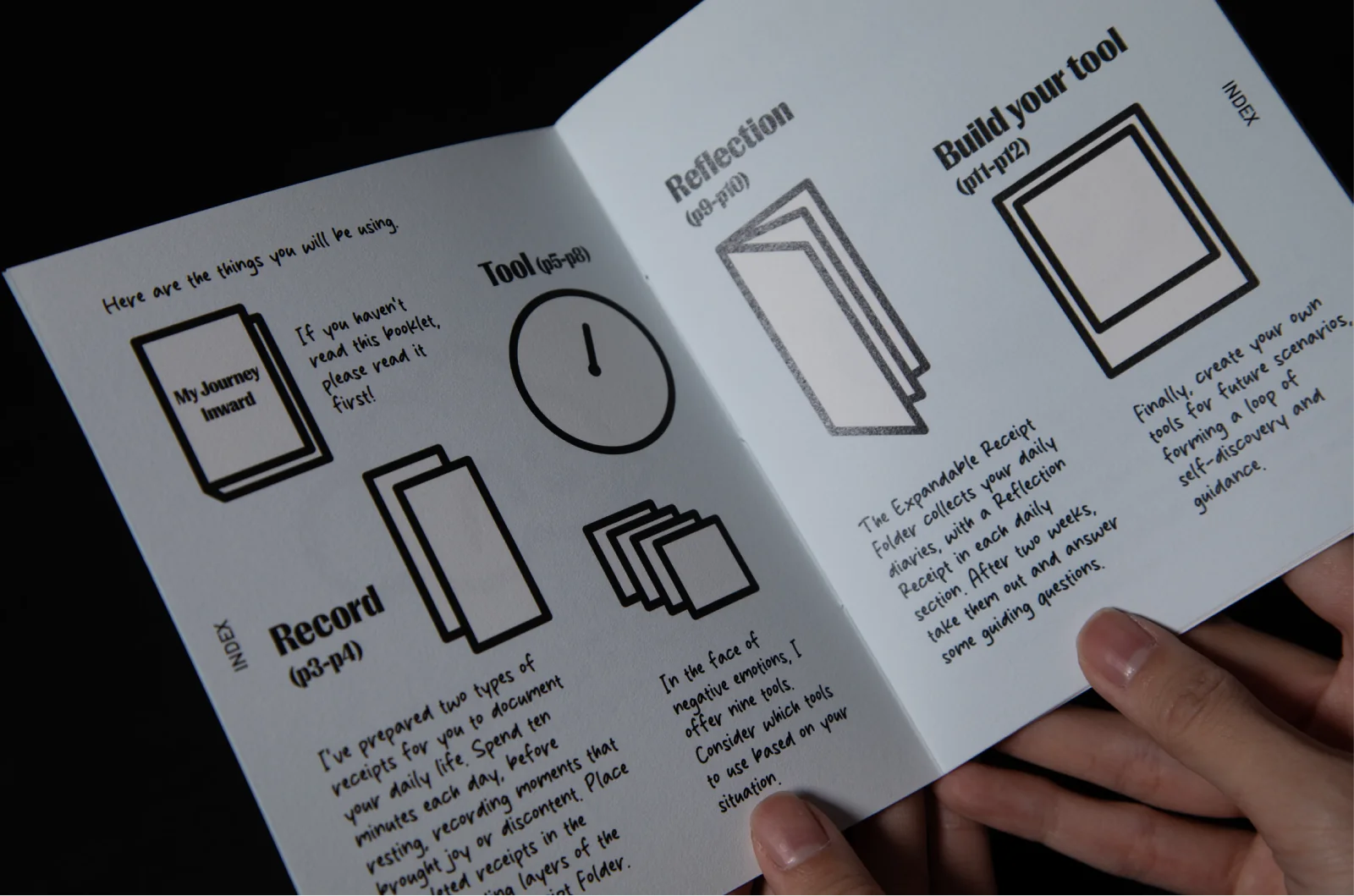
A basic booklet explaining each part of the kit, and the reflection steps once the two weeks are up: Diary, Tools, Reflection, and For the future.1
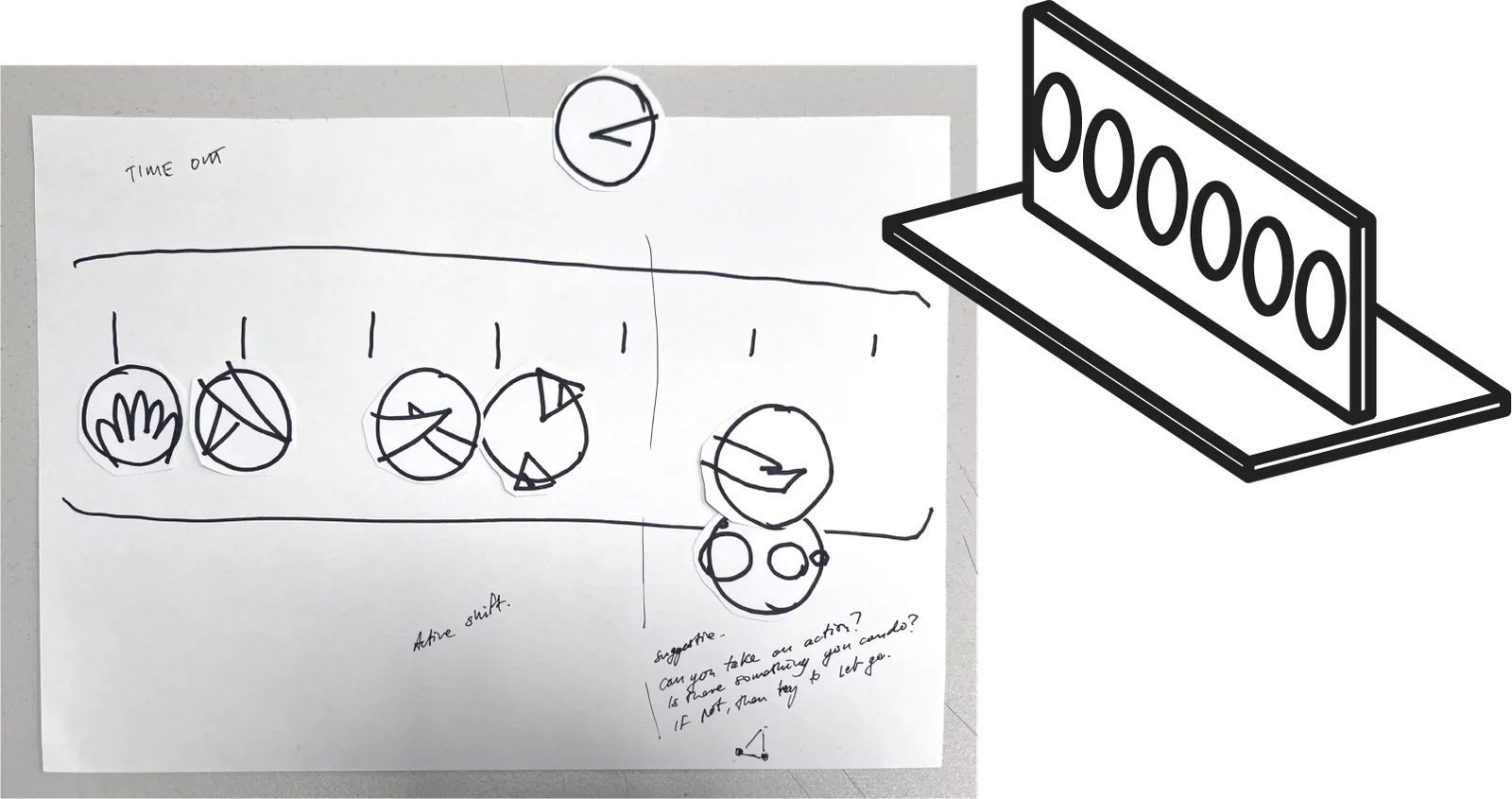
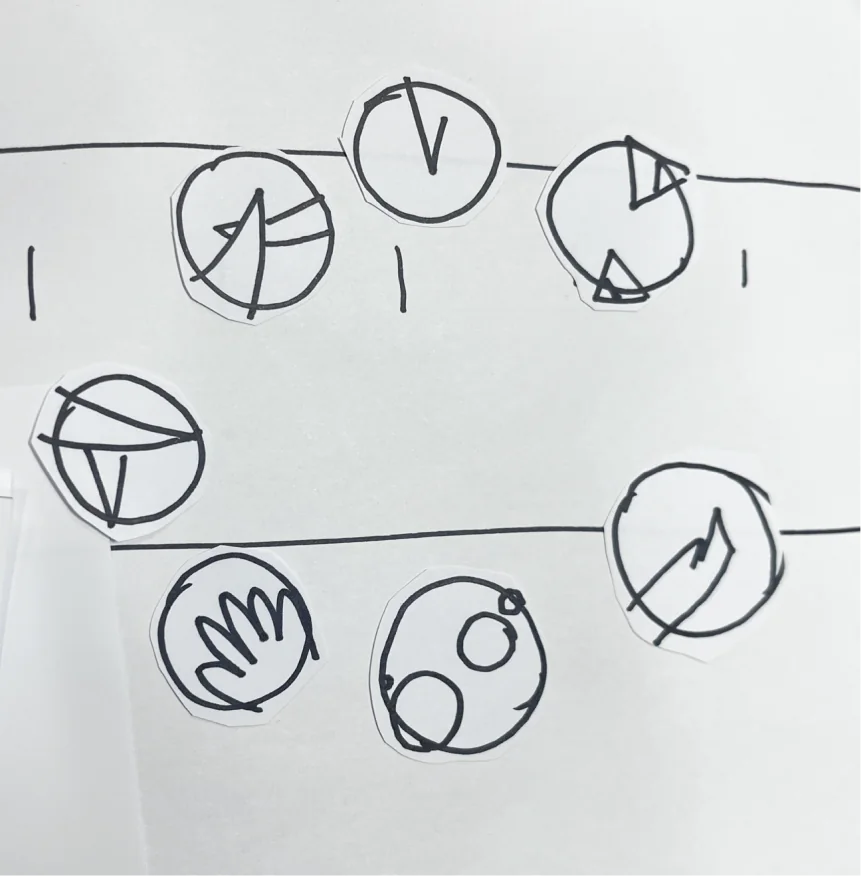
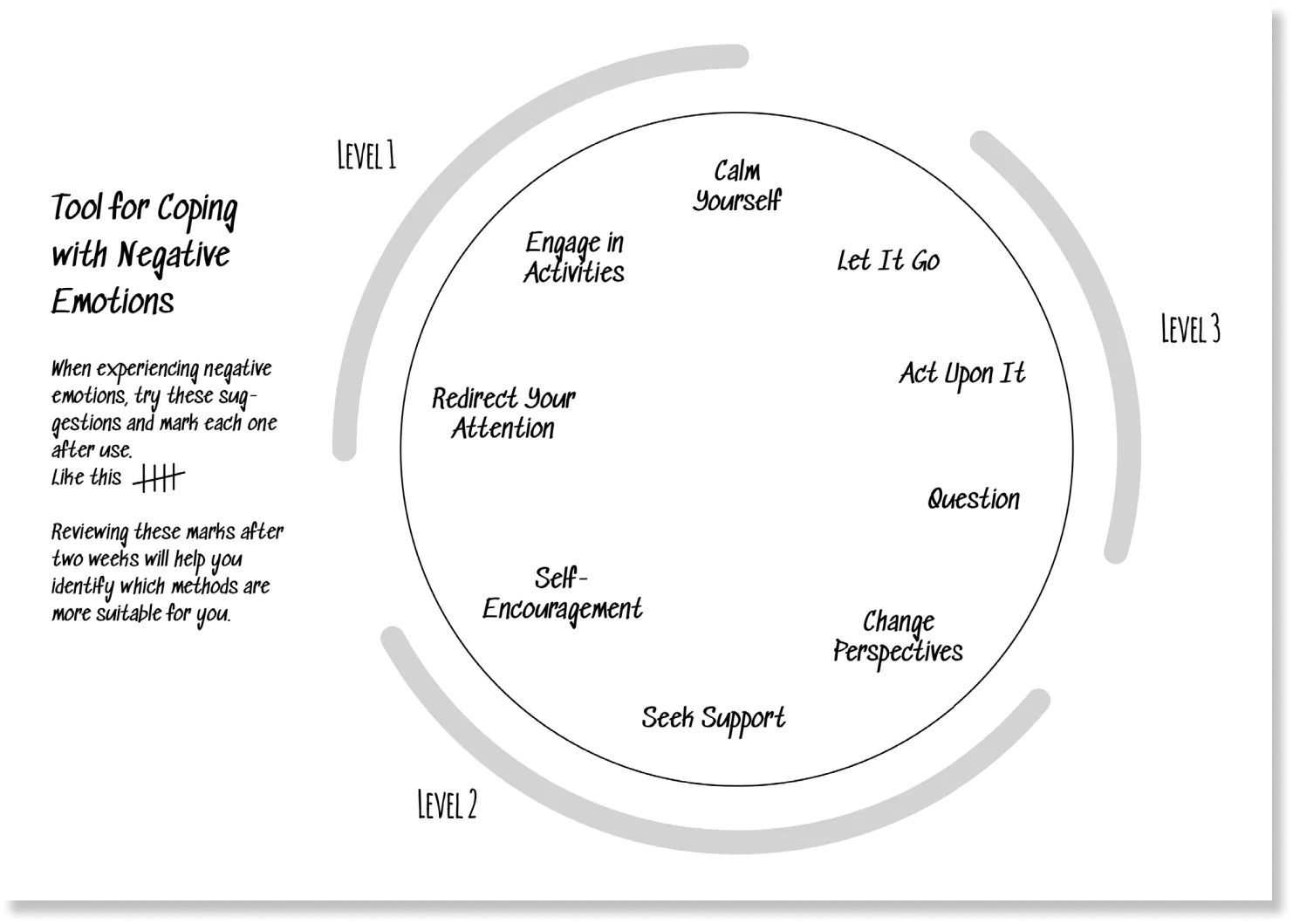

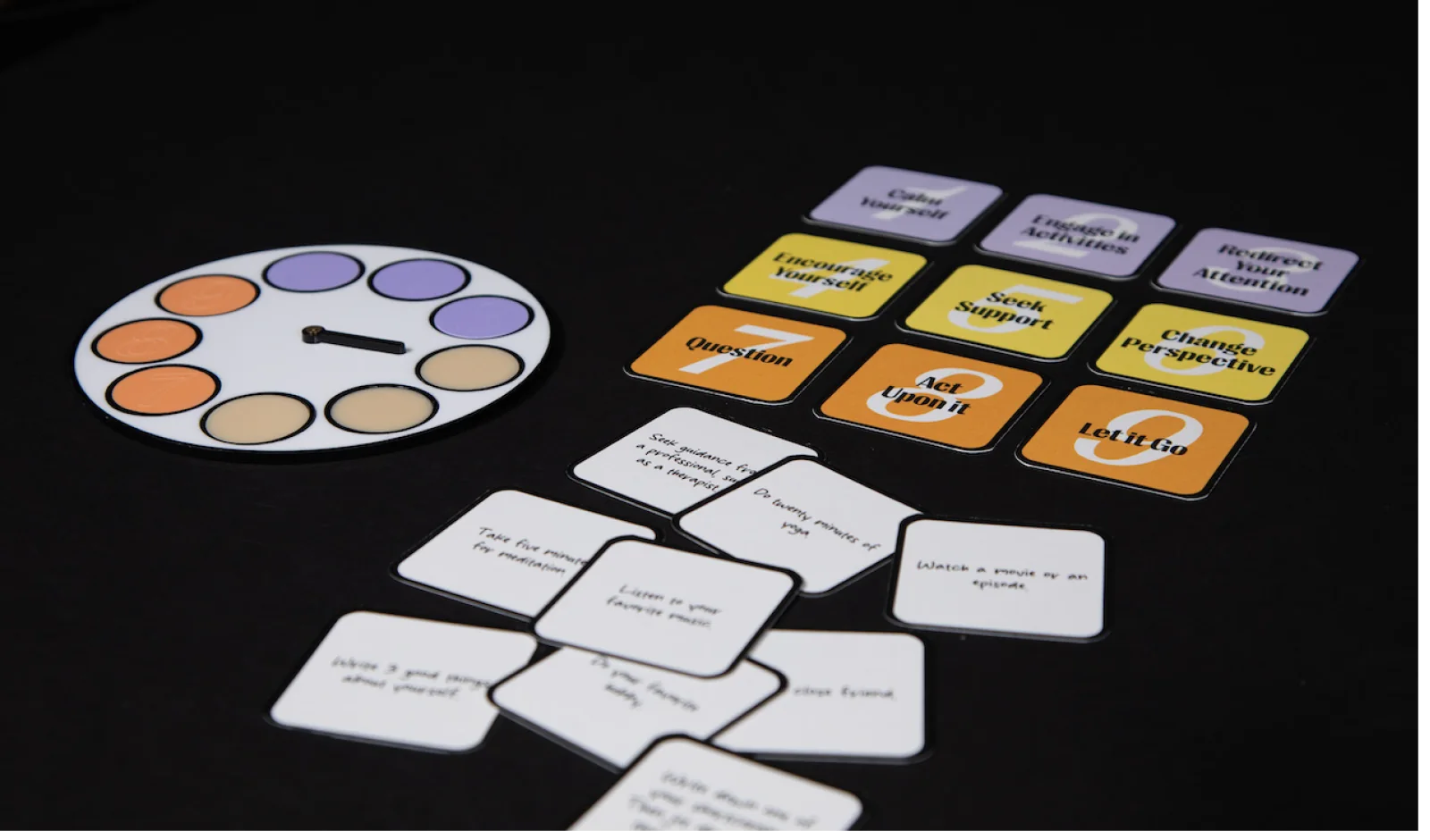
Suggestions in three groups — Calm down, Active shift and Take action — drawn from the workshop and the research.1
Made into an interactive desk object: the layout changed from linear to circular, and icons were replaced with text.2
Participants used the kit for several days. Feedback was positive, but a few problems came up, which led to the changes below.
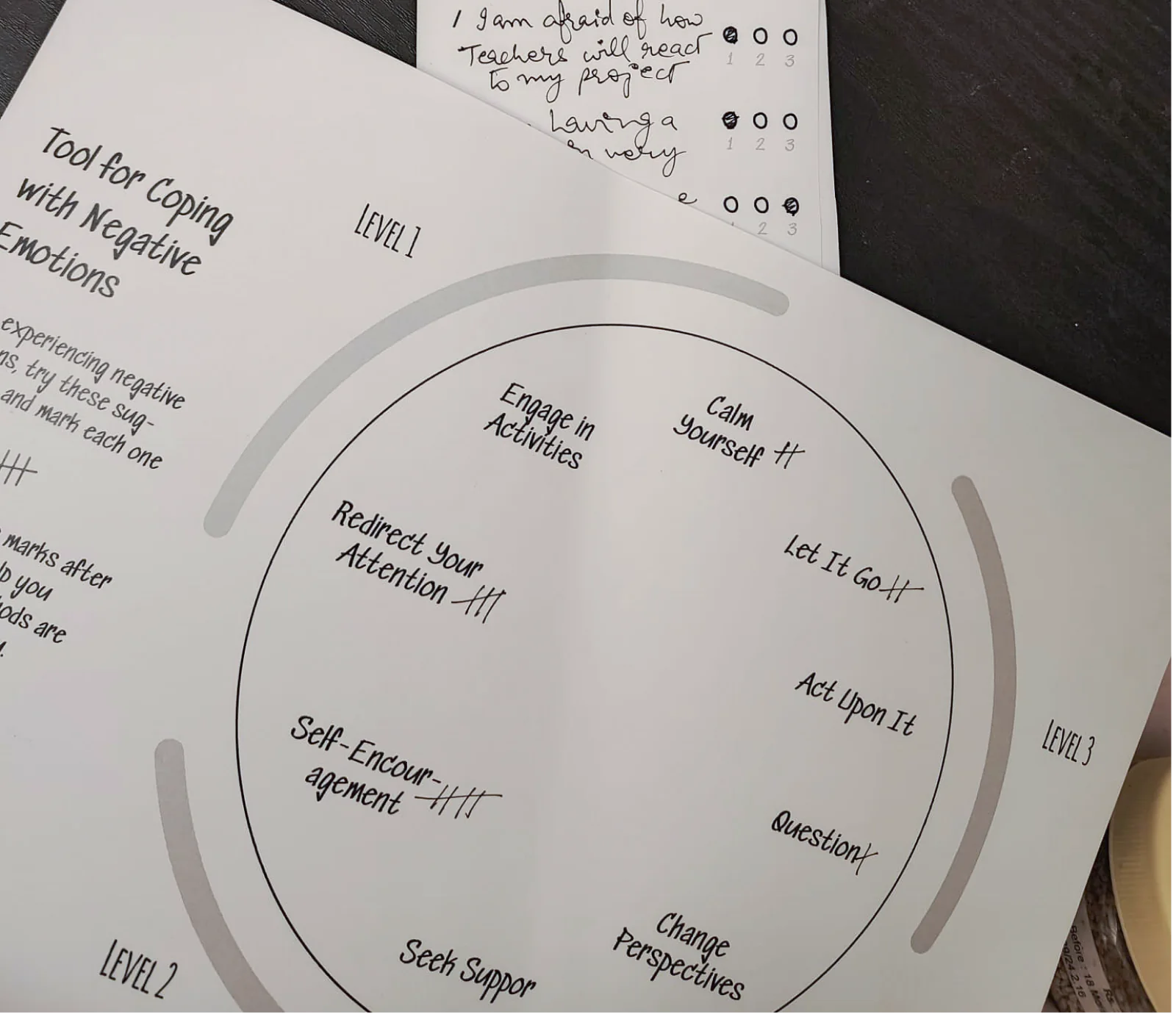
“I felt your project is a great starter kit when it comes to putting us in a habit of contemplation. It can tell you different options and you actually end up choosing one of them to calm yourself.”
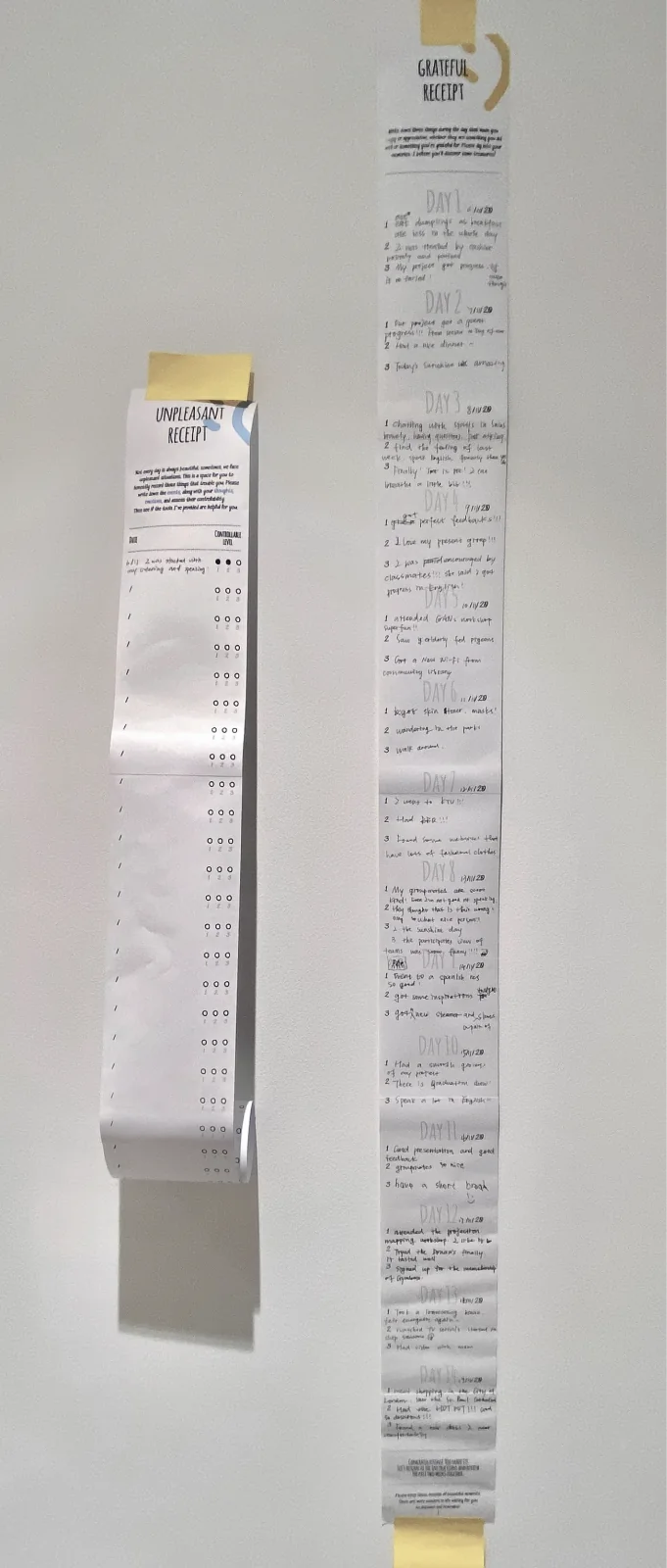
“Looking back at the Grateful Receipt reminds me of the things that made me happy.”
Problem Users weren’t motivated enough to keep recording every day.
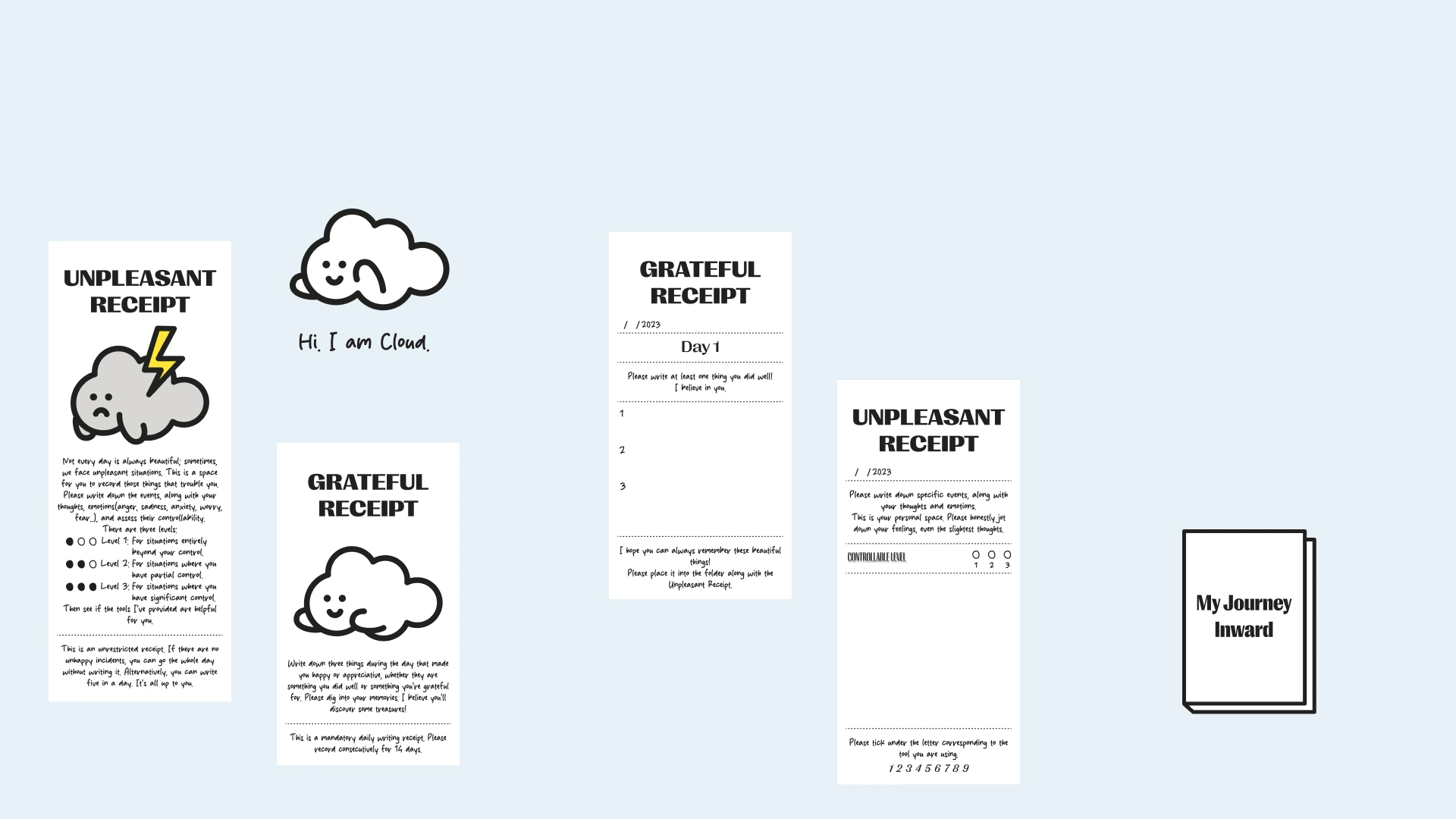
Designed branding around the “Cloud” mascot, symbolizing how the water cycle represents the cyclical process of self-reflection.1
Transformed receipts into concise daily entries with motivational phrases, each unique and derived from my autoethnography journey.2
Compiled “My Journey Inward,” detailing self-discoveries from my autoethnography. Introduce my story: what I have learned from my negative and positive emotions.3
Problem The tool’s advice was too abstract, with no concrete next step.
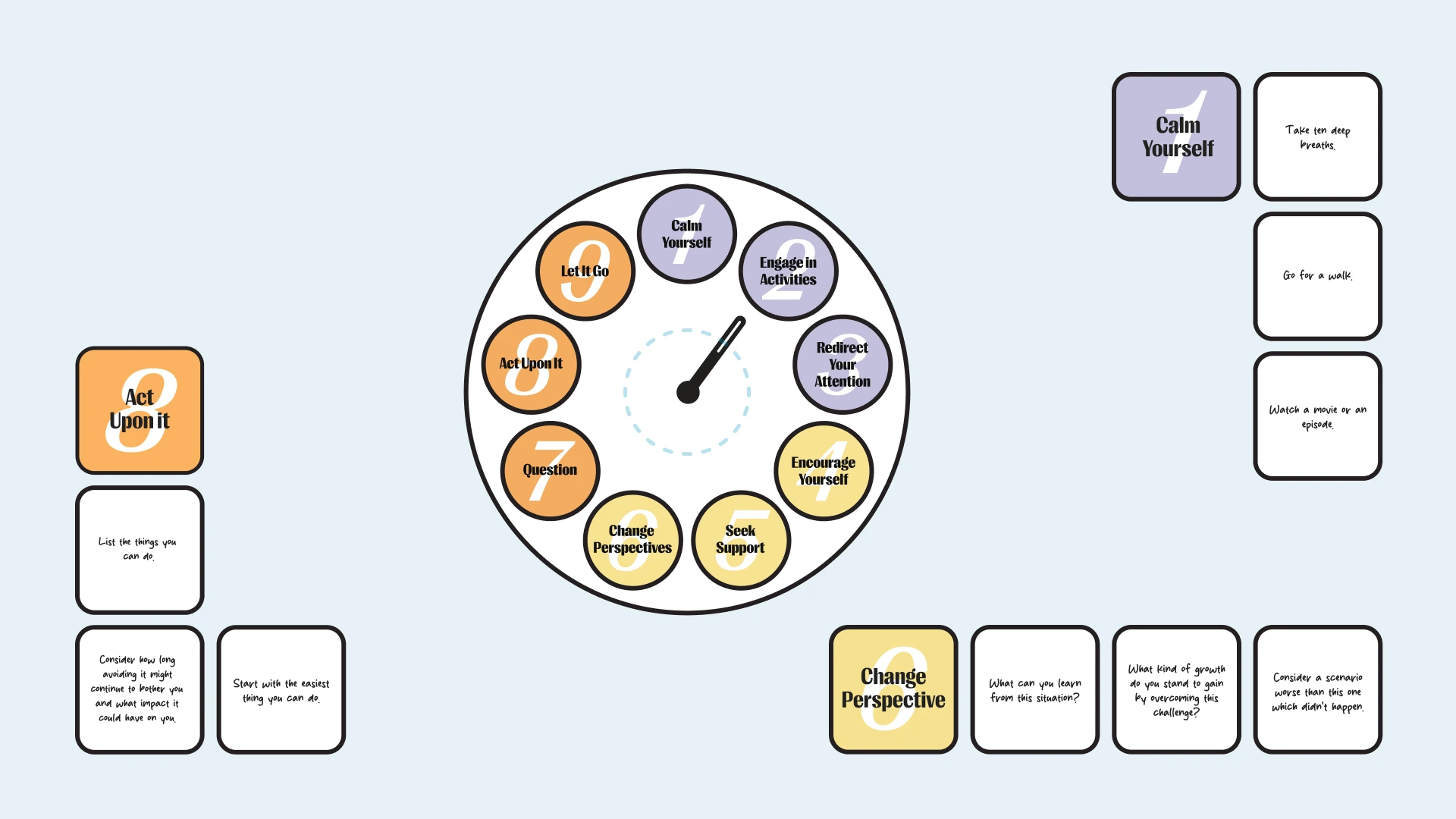
Transformed vague advice into concrete action cards, providing clear, immediate strategies for emotional coping.1
Users turn the pointer while deciding which tool suits how they feel right now.2
Problem Receipts needed somewhere private to live, and the review at the end needed more structure.
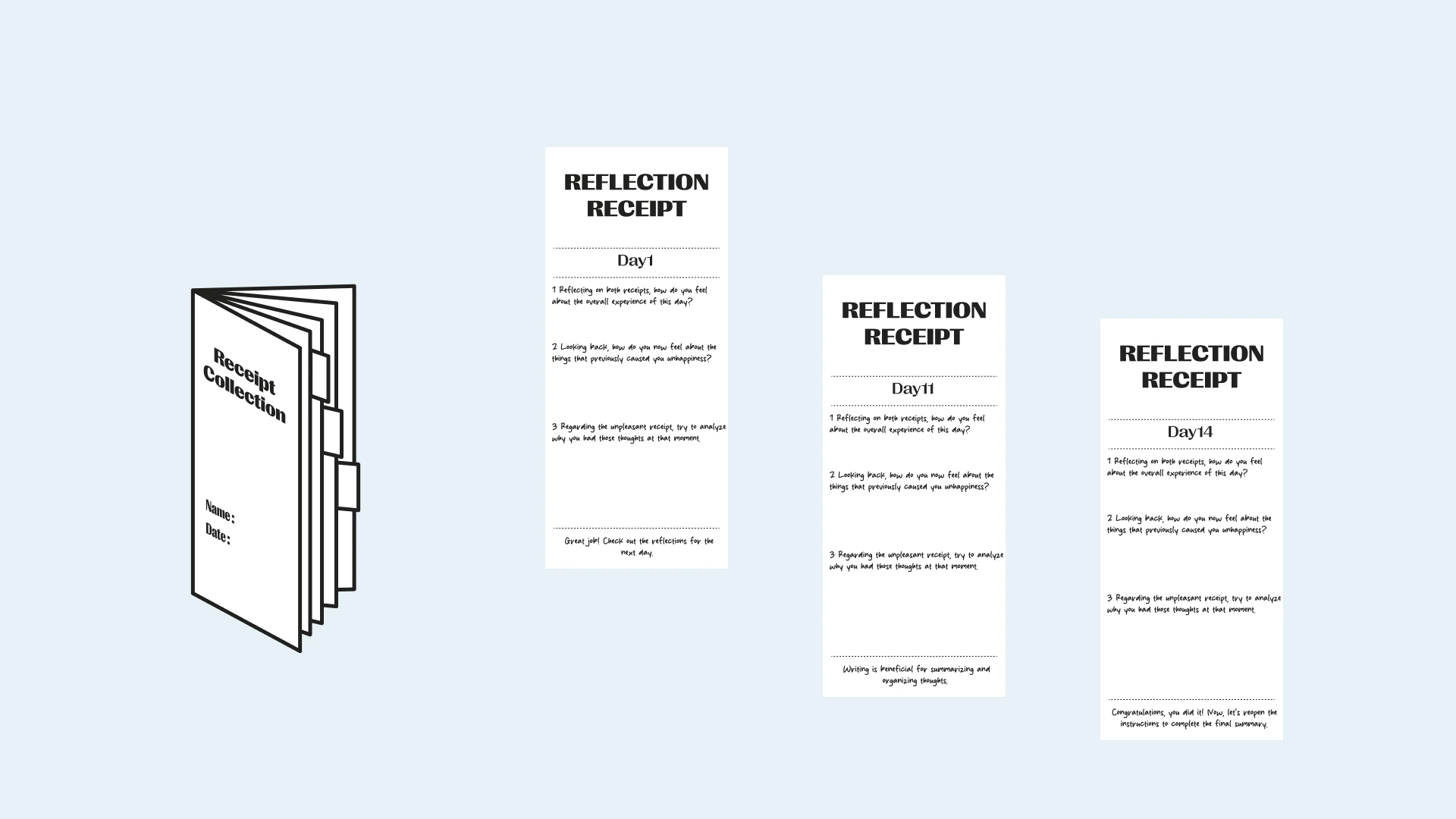
Designed the storage approach with a new folder layout.1
Introduced 14 “Reflection Receipts” for orderly daily thought review, promoting deeper introspection.2
The finished kit: receipts in their box, the receipt collection folder, the coping tool and action cards, the instructions, and My Journey Inward.
The kit works as a prototype. Two things would take it further.
Testing ran over a few days; the kit is built for two weeks. Only a whole cycle shows whether the daily writing sticks, and whether the reflection at the end repays two weeks of receipts.
The kit stays at home, but the moments it is for often happen while people are out. A phone app would let them quickly record an event that set off a negative feeling and choose how to respond to it, there and then.
Next in the file
 Little Wood Home
Feb 2023 — Mar 2023
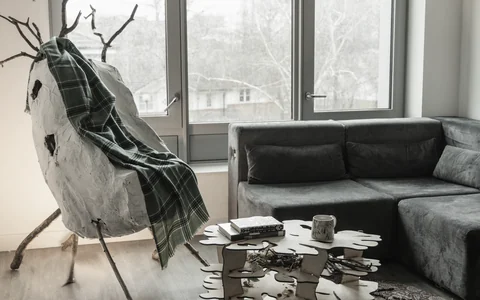
A speculative room tour exploring how domestic space could become a shared habitat for humans and non-human species.
P-ID 0223 0323 · 02
Little Wood Home
Feb 2023 — Mar 2023
A speculative room tour exploring how domestic space could become a shared habitat for humans and non-human species.
P-ID 0223 0323 · 02